
Let me know if I’m wrong, but I’m assuming none of my Oklahoma folks on Facebook or LinkedIn went to the 1964-65 World’s Fair. Even the oldest of us are too young to have done that. But perhaps like me, you had family members that made their way to Queens for the event. My parents did. Dad was a delegate to the 1964 Democratic Convention in Atlantic City, so while they were in the area, they took the train to the country’s largest city to see the world’s largest international exposition.
I didn’t know they’d done this until at some point in the mid-70s, when I noticed a box in the back of the closet of the spare room that had become my bedroom. Inside were tickets, programs, flyers, and credentials from the convention, including a badge with a red, white, and blue ribbon, labelled Platform Committee. I can’t imagine Dad scrounging around an emptied-out convention floor and snagging someone else’s badge. It was his. Which means he was on the committee that put Lyndon Johnson’s official policies and principles in writing. Here’s what they settled on.
That box also had tickets, maps, and brochures from the World’s Fair. When I showed these to mom, I was expecting a response like, “Oh, so that’s where that box went off to. I’ve been looking for it!” Instead it was more like, “Oh yeah, we went. It was fun.”
______________
Here’s what recently turned my attention to the World’s Fair: a few weeks ago I self-toured the Surrogate’s Courthouse, a magnificent early 20th-century building in the municipal district of downtown Manhattan. In a ground floor alcove just off the courthouse’s glorious central atrium, there was a small exhibit on the 1964-65 exposition, with maps, programs, souvenirs, and exhibition highlights. Wow, somehow Robert Moses and Cardinal Spellman got the Vatican to ship the Pieta to Queens to be displayed in its own bespoke pavilion. The Pieta!
There was a mounted map of the fair with an accompanying list of pavilions. I wasn’t looking for Oklahoma. I didn’t even know individual states had pavilions there. But there it was, Oklahoma, in the state pavilions section, between New York and Oregon. But wait, alphabetically, there are states between New York and Oklahoma. So not every state represented itself at the fair. According to the listing for that map, only 23 states had pavilions.
And Texas was not among them.
Really? Texas passed on putting on a show at a World’s Fair? Well of course they didn’t.
______________
Now I know that Texas indeed represented itself at the fair. And as you would expect, they did so in an outsized way (they actually referred to their setup as “pavilions.” Plural). Led by Angus Wynne, the guy who started Six Flags over Texas, the project included a 2400-seat music hall and a Western-themed restaurant and bar that could hold 650 people. The music hall staged several performances a day of “To Broadway with Love,” a non-Texas specific review combining well-known and original tunes. The review was created by top theater professionals, including the director of The Music Man (the musical and the movie), the songwriters for Fiddler on the Roof (which opened later that same year), and lots of New York-based talent. There’s a cast album!
But there’s a reason Texas wasn’t on that list of state pavilions. The map was from the second season of the fair. The Texas pavilions closed just two months after the fair opened. That stage show, while praised by theater critics who seemed surprised at how good it was, was extraordinarily expensive and didn’t exactly pack ‘em. The location didn’t help. The enterprise needed so much space that it had to be constructed in a remote part of the fairgrounds, about as far from the entrance as it could be. To get there, fairgoers had to go past a lot of other pavilions, then take a footbridge over the Long Island Expressway. It’s easy to imagine that many visitors would be all Fair’d out by the time they got to that bridge.
In June 1964, the organization that created and operated the Texas extravaganza at the fair declared bankruptcy and the whole thing was down.
______________
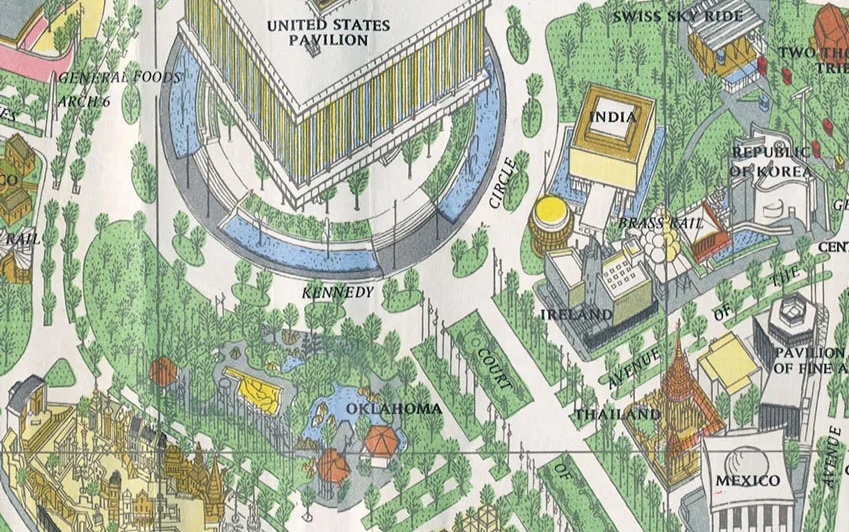
By comparison, the Oklahoma Pavilion was more modest in size and expense (how could it not be?) but also better located, situated next to the United States Pavilion not far from the entrance. It too wasn’t strictly speaking a pavilion, but it also wasn’t a logistical challenge for visitors hitting their walking-around limit.
It was instead a solution, a park within the park, with winding pathways, little pools, and places to relax in the shade, all centered around a sunken topographical map of the state. Here’s the program from the tree planting ceremony held in September 1963, seven months before the fair opened.
Oklahoma’s area also provided music, but with homegrown talent. A band shelter designed to look like a log cabin’s front porch featured musicians from the state, including brass bands and symphonies. Visitors could pick up a box lunch or bring food they’d gotten elsewhere in the fair and settle in for a picnic.
For the fair’s second season, the place that provided the box lunches was converted into a Chicken Delight franchise (“Don’t cook tonight. Call Chicken Delight!”). As far as I can tell there was only one Chicken Delight in Oklahoma at the time (in Tulsa), but it was, for a time, a popular chain in the Northeast, Midwest, and Canada.
______________
Several standout structures built for the 1964 World’s Fair are still standing, among them the Unisphere and the viewing towers from the New York State Pavilion (both recognizable from Men in Black), and the Queens Museum (formerly the New York City Pavilion) where a spectacular scale model of the entire city created for the fair is still on view in its original home. A number of structures were purchased and relocated. Here’s a list of them, but I’ll highlight a few: The geodesic dome is now the aviary at the Queens Zoo in Corona Park. The original version of “It’s a Small World” is the one at Disneyland. The Johnson’s Wax kiosk is now the Golden Rondelle Theater in Racine, Wisconsin. The Austrian pavilion became a ski lodge it upstate New York, but sadly, it was completely destroyed by fire in 2011. The Pavilion of Paris is now the Skylanes Bowling Alley in East Stroudsburg, Pennsylvania.
As for Chicken Delight, it’s U.S. presence shrank significantly as that Kentucky-branded operation surged to dominate the market. New owners took over in the late 70s and decided to focus on Canada, eventually moving corporate headquarters to Winnipeg. Currently, there are 17 Canadian locations, down from a peak of about 50. And there are still a half dozen independent Chicken Delight restaurants in the northeastern U.S., one on Long Island and the rest in New Jersey, but they’re not officially affiliated with the Winnipeg-based chain.
Leave a Reply