
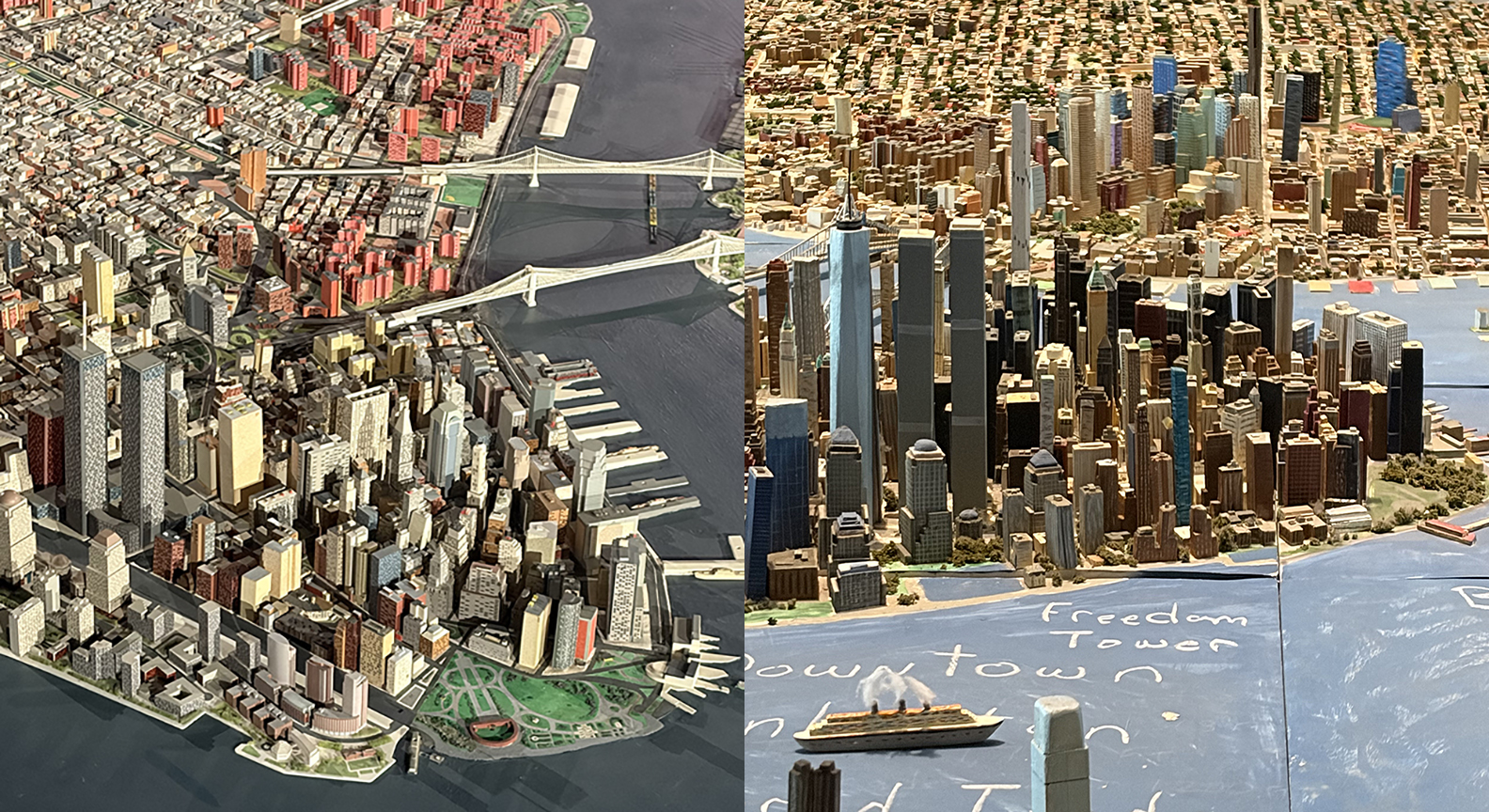
In an interview earlier this year, the mayor of New York was asked to recommend something for visitors to the city to do, something that might not be on a typical traveler’s agenda. His answer: go see the panorama of the city of New York, a scale model of the five boroughs with meticulously realized, miniature versions of every street, every building, every bridge and park, every everything.
I couldn’t agree more. It’s a spectacular achievement.
Commissioned by Robert Moses for the 1964 World’s Fair, the panorama is the stunning centerpiece of Queens Museum in Corona Park, still on view in its original location. That building was the New York City Pavilion for both the 1939 and 1964 expositions. From 1946 to 1950, it was the first U.S. headquarters of the United Nations General Assembly.
The mayor is from Queens, so, of course, he’d draw attention to one of his home borough’s most appealing attractions. But wait — the panorama the mayor was promoting wasn’t that one.
There’s another one.
It’s been on display at the Museum of the City of New York in upper Manhattan since February 2026. And unlike the panorama in Queens, the one at MCNY wasn’t created by professional craftspeople or intended for grand public display.
It’s the work of one man.
Joe Macken.
Here’s Mr. Macken’s story in The New York Times. It explains why a beverage delivery truck driver living 165 miles upstate from New York City undertook such a monumental project, and how he pulled it off single-handedly. No need for me to summarize and paraphrase, or act like I did any more research on him than reading this myself. What I did do was make recent visits to both panoramas.
________________
The Tale of the Tape
| Model Comparison | Moses’s | Macken’s |
|---|---|---|
| Size | 154.5 x 137 ft | 50 x 30 ft |
| Scale | 1 in = 100 ft | 1 in = 160 ft |
| Panels | 273 | 340+ |
| Structures | Approx 895,000 | Approx 800,000 |
| Empire State Bldg | 15 in. tall | 7.75 in. tall |
| Made of | Formica panels, urethane foam, wood, plastic, hand painted paper, etched brass, laser cut/ etched acrylic | Balsa wood, foam board, cardboard, Elmer’s glue, cut with an X-Acto knife |
| Estimated cost | 1964: $672,662.69 1992 renovation: $2 million | Approx $20,000 over two decades |
________________
The Presentation
It wasn’t until I put this table together that I realized just how much smaller the Macken model is compared to the Moses model. It seemed plenty big to me. It’s so wide for the room it’s in that you can’t walk all the way around it. You can go about a third of its length on either side but that’s it. To view it from the Bronx down, you have to step out of the room, walk down the hall past the elevators, go through the coat check room out onto a terrace, then back in through a glass door. Where you can stand next to the platform, binoculars are provided to help you see what you want to see up close.
As for the Moses model, I’d forgotten just how big it is — almost half an acre. You can’t fully circumnavigate it either but you can get most of the way around it. You can also get above it, entering from the first floor and taking the curving walkway up, or from the second floor and taking it down. That elevated perspective made it easier for me to see personal landmarks, including my apartment complex. This was harder to do at the Macken model, even with binoculars. Our building isn’t totally engulfed by taller ones (we’ve got quite the southern view from our place), but looking across at eye level from the closest viewing spot, that’s the way it appeared. It wasn’t until later, when I enlarged a photo of my neighborhood, that I could pick out a blurry version of my home. I suppose if I were taller…
That walkway is just one advantage the Queens panorama has of being in a space specifically built for it. Another is the programmed lighting cycle that simulates a 24-hour day — overhead lights dim and brighten as the city lights brighten and dim. Then there’s the airplane taking off and landing at LaGuardia Airport. It’s tiny, less than two inches long, attached to a barely visible wire. A pulley system brings the plane from the top of one side of the room down into an opening in a runaway. It’s out of sight for a few seconds, then emerges at the runway’s other end, ascending to the second floor on the other side of the room. From there, it goes across the ceiling to start the journey over again.
________________
The Look
In addition to being larger, the Moses panorama is more polished, shinier, sturdier, exactly what you’d expect from an expensive project commissioned by a driven taskmaster and created with hi-grade materials and precision tools. As well-crafted as Macken’s model is, it does have characteristics that make it look like it was made by, well, a guy — the construction paper, the names of the waterways written by hand, the slight building leans here and there.
But those things make Macken’s work all the more impressive. Yeah, it was made by a guy. In his spare time. With no formal training at doing anything like this.
One guy.
________________
The Era
The Moses panorama introduced at the World’s Fair showed the city circa 1964 and it remained unchanged for nearly three decades. Soon enough, “that’s the way it is” became “that’s the way it was.” Now the model shows New York circa 1992, when a $2 million renovation was completed. Which means, among many other differences from the city today, the original World Trade Center is still there.
Macken began his model in 2004 and the version on display shows his progress as of 2024, so it’s much more up to date. But he has said that in several instances, places that were a part of his childhood in the city are presented as he remembers them, not necessarily as they are now. Fair enough. It is his model. As for the World Trade Center, he has it both ways. The Freedom Tower and other new buildings at Ground Zero are in place, but the original Twin Towers are there as well.
________________
The Museums
The Moses panorama, with its adjacent exhibit of World’s Fair artifacts, is the most compelling reason to visit the Queens Museum., but there are always other things going on. The first time I went to see it (just after the 1992 restoration was completed) there was a terrific, sometimes gruesome showing of police photography. On my latest visit, I learned all about the city’s water supply system from another scale model, a 600-square foot relief map showing reservoirs, groundwater sources, controlled lakes, aqueducts, etc. Made of 27 interlocking panels, it was commissioned for the 1939 World’s Fair and spent decades in storage before being restored and put on display again in 2008. Wow, that stuff coming out of my tap could have come from over 125 miles away. From Pennsylvania!
Corona Park itself has an abundance of attractions, including a zoo, a farm, a botanical garden, the Hall of Science, the National Tennis Center, a recreation center, playgrounds, picnic areas, athletic fields, and some notable leftovers from the World’s Fair (Men in Black fans will recognize the Unisphere and what remains of Philip Johnson’s New York State Pavilion). CitiField is just across Roosevelt Avenue and a new hotel/casino complex is being built next to the stadium.
As for the Museum of the City of New York, it’s become a favorite. Long-running exhibits on New York’s history of activism, the evolution of its economy and ethnic diversity, and its role as a major U.S. port city are all worth of repeat visits. I was there just last January to see an interactive exhibit on music from the five boroughs and a video installation on movies filmed in the city. I can’t account for why I knew nothing about the Macken model before the mayor mentioned it. I didn’t notice any announcement about it on my previous visit, which was only a month before it went on view. Which is not to say there wasn’t one.
Even if the Macken model hadn’t been there, I’d have headed up to 103rd and Fifth Avenue at some point this fall anyway, to learn about the British occupation of the city during the Revolution and to see this extraordinary WPA-funded mural cycle of Alice and friends visiting New York. The paintings were originally installed in the children’s ward of a Lower East Side hospital in 1940. They were nearly destroyed in 1981 when that hospital was condemned and torn down, salvaged by a team of art restorers and volunteers just as the wrecking crew arrived. It took decades to bring them back to their original vibrancy. One had to be completely recreated from photos. You can tell which one it is. It’s a little brighter than the others.
____________________
These comparisons aren’t meant to suggest that one panorama is any more or less worthy than the other. Each is magnificent, each accessible with a little effort. But if you want to see them both, you’re going to have to hurry. While the Moses panorama is always on view in the Queens Museum, MCNY’s Macken exhibit is set to end mid-October. The room will soon be taken over by the winning entries from the museum’s annual competition, Gingerbread NYC: The Great Borough Bakeoff, where contestants recreate New York landmarks and cityscapes using the holiday favorite as their primary building material. And Macken wants his model back to keep working on it. He wants to add more of Long Island and parts of New Jersey.
That “Another Wonderland” mural cycle is leaving MCNY in mid-October as well, but the paintings will soon be installed in the pediatrics area of Gouverneur Heath, a couple of blocks from their original home.
Leave a Reply