
I have two versions of a bleu de travail (“work blues”), a loose-fitting jacket traditionally worn by French tradesmen, factory laborers, agricultural workers, and inmates. Each is a wow-that’s-blue blue. I first learned of this type of jacket while watching a documentary about the New York Times fashion photographer Bill Cunningham, who used the deep pockets to carry extra rolls of film and other supplies as he bicycled around the city.
I got the heavier of the two bleus in Paris, at a stall outside the covered market in the Marais. It’s cerulean blue, the weight of a jean jacket, perfect for a 50-60 degree temperature range. But for this day, Tuesday, June 16, I needed the other one, bought from a Brooklyn vintage store — admiral blue, lighter in weight, more like an overshirt but still recognizably in the “work blues” style. So much so that upon seeing me wear it, a friend of mine from France asked if I’d just been released from Devil’s Island.
I needed that jacket because I was going to be outside that late spring afternoon, either in the shade where things could get cooler as the day went on, or exposed under a cloudless sky, most of a stadium’s height closer to the sun, where I’d need arm and neck coverage. This jacket was the day’s best option for either situation, not just for its thinness, but for its Frenchness.
Because, as I’d been informed the evening before, I was going to see France versus Senegal in the World Cup.
________________
The World Cup!
My son began playing soccer when he was nine, and played through high school and college. From the time he started, the sport became a defining family thing. We were devoted soccer parents, learning the basics of the game by observing him on the pitch or by listening to him while watching matches in person or on television. I still ask him if we’re seeing the flow of a game the same way and if he sees it differently, I assume he’s right.
When New York City’s first Major League Soccer team was announced in 2014, my wife signed us up as founding members and we’ve been season ticket holders ever since. We’ve seen a number of high-profile exhibition matches as well, with world-class superstars: Messi, Ronaldo, Henry, Gerrard, Lampard, de Bruyne, Haaland. Manchester City, Liverpool, Real Madrid, AC Millan. Argentina/Brazil on a blisteringly hot day, USA/Argentina on a freezing cold night. On my son’s graduation trip to London, he and I attended the 2018 Premier League Community Shield match at Wembley Stadium. Man City beat Chelsea 2-0.
But this was the World Cup.
In 2024, FIFA confirmed MetLife Stadium as a 2026 World Cup site. My son didn’t ask if we could go. He just said, “We’re going.” I responded, Of course. Because, why not? It was certainly a possibility and 2026 was a long way off. But suddenly, it was 2026. The Cup was only months away, then weeks, then upon us.
I just assumed he’d been tracking ticket prices, waiting for them to drop. That was his way of getting into NBA games. How many times had I heard him talk about holding out till the last moment, then paying a preposterously low amount to see the Heat, the Nets, the Thunder? I left it to him. And whatever number he quoted, I knew I’d pay it. I’d think, “That‘s a lot of groceries there,” but I’d pay it.
Just before the World Cup kicked off, my son told us he was going to an opening round match in Philadelphia: Ivory Coast versus Ecuador. A college friend had gotten free tickets from his company and offered him one. I felt more relieved than abandoned. He was going to tick that World Cup box without me agonizing over ticket prices. I was happier that he was going to a match than disappointed I wasn’t.
He’d planned to join us for dinner night after the Philadelphia match, but we got a message that he was working late and should eat without him. Then, later in the evening, he showed up. To tell me we were going to see France/Senegal the next day.
So I really wasn’t taking him after all. He was taking me.
________________
He’s a Planner
And so, he made The Plan.
Back in the 70s, when my dad was loading us out to go to Oklahoma Sooners football games, he’d say he wanted us at the stadium in time to see them “air up the balls and stripe the field.” For this event, my son proposed a similar strategy. We’d be leaving exceptionally early. Instead of going by bus out of the Port Authority like we usually did for Giants games, we’d be taking the train, but we’d avoid Penn Station by going through Hoboken instead. At Penn on Meadowlands match days, New Jersey Transit was only allowing passengers into their concourse if they had game tickets. So in addition to crowds of visitors unfamiliar with the station trying to figure out where to go, there’d be a lot of confused non-matchgoers who hadn’t gotten the message that their plans might be disrupted. Or who’d gotten the message but didn’t really believe it applied to them.
Going by train to the stadium meant paying the startling fare that had been much in the news (still startling even after it was reduced by a third). But Lord knows how much the match tickets cost. I didn’t ask and never will. I booked our round trips that Monday night, confirming the purchase to him by showing the tickets safely tucked away in my phone wallet.
________________
Match Day
The first step in The Plan was to meet at my son’s apartment building in the Financial District by 9:30 am to go to breakfast. I’ll admit I was a little restless the night before, worried I’d be late, thus destabilizing The Plan from the outset. But I got to the bus stop at my targeted time (whew!). Traffic was sluggish for the first few blocks, typical for a Tuesday (garbage truck day in our neighborhood). But things loosened up past 14th Street. I was in his building’s lobby at precisely 9:28. We were in and out of Squires Diner at times that satisfied Steps 2 and 3 of The Plan.
While at breakfast, he took note of my bleu de travail and I explained that I indeed wanted France to win, but I had other reasons for bringing it. He approved. He was wearing shorts and a t-shirt. At least he’d brought a cap.
Next came the walk across Fulton Street and into the Oculus, then across its lower level to the PATH train station, which sits under a vaulted ceiling with support arms that make it look like you’re inside a gargantuan rib cage. Even though kickoff was a good four hours away, I assumed we’d need to queue up for the escalator down to the track, but there was, as of then, no swarm of fans. The station looked to be experiencing nothing more than a typical weekday – loads of people coming into New York, a few going out to New Jersey. The ride to Hoboken took 11 minutes.
We saw a few people that morning — in the diner and on the walk across town – who’d prompted one or the other of us to say, “Bet they’re going.” And we weren’t the only riders on the PATH train that looked to be headed to the stadium. But it wasn’t until we were upstairs at Hoboken Station and heading to Track 16, that we found ourselves in a thickening flow of matchgoers. Still, as we made our way to our train there was never a stackup, never an uncomfortable squeeze, no one elbowing past us to board just a few people faster. No one else was in a hurry so we weren’t.
New Jersey Transit was ready for us. The phalanx of state troopers, normally intimidating in their blue uniforms and Mountie-style hats, were instead a jovial part of the welcoming atmosphere. There were greeters all along the way in fluorescent vests, evenly divided between big-smile young women and big-smile older men. We were well ahead of the 12-1 pm departure window on our tickets, but the man who scanned us through didn’t care. He was one more happy person moving us along. We needed wristbands to show we belonged on the train, and the woman who put mine on said, “There you go!!” like a pilot pinning plastic wings on a young first-time flyer. She added, “Now, don’t you lose that! You’ll need it for the ride back!”
The train was one of New Jersey Transit’s double deckers. We went to the upper level of the rear car and got two seats facing forward. Once we pulled out, the last bit of worry that I’d mess up The Plan fluttered away.
We really were going.
________________
There…
We didn’t have to change trains in Secaucus, as Meadowlands passengers often do. We could stay relaxed in our seats as matchgoers coming from Penn Station switched to our train and hunted for seats in already-occupied cars. But even with that fresh influx of riders, some standing in the aisle, our car didn’t feel overcrowded or overexcited. Signs indicated that this was a Quiet Car, but it seemed to me that the low volume of conversations was because people were content, not because they were obeying orders. No one was speaking in a theatrically loud voice to make sure we all knew what a clever, good-time person he or she was. Maybe it was just too early for anyone to have racked up a few beers.
At the Meadowlands, the train stops between the East Gate of the stadium and a walkway to the American Dream Mall, the massive shopping and entertainment complex which features, among other things, an indoor ski jump. It had been such a mellow ride to that point, that I was surprised to see how many people were on our train. Exiting from the last car put us at the end of a platform-wide, platform-long flow of passengers. We were herded by fencing to the top of the main parking areas at the northwest corner of the stadium, becoming part of a growing crowd but never hurried and never at a standstill.
A final right hand turn had us facing something like 40 lines of ticket scanners. We were in a foot traffic version of a New Jersey Turnpike exit, where you try to guess which lane will get you through to the tunnel the fastest. My son took us farther and farther over until the lines became noticeably shorter. Once we settled on one, things slowed down just a bit but again never came to a complete stop. After our tickets were scanned by yet another cheerful attendant, there was one last checkpoint: the metal detectors. We were held up there by ticket holders who had to discard bags and bottles and other items long banned for any event in the stadium, not just the World Cup. But the delay was negligible.
We were in.
________________
The Fan Experience
On Giants game days, the parking areas at the stadium host some of the most ambitious tailgating imaginable. Not talking sandwiches and card tables, folks. Portable awnings, collapsable furniture, grills big enough for a family reunion, propane tanks and beer kegs, mixed drink capabilities, all species of grilled meats. There’d be dozens of big screen TVs in the opened backs of SUVs and minivans, and footballs, frisbees, and cornhole bags in flight. You’d see jerseys for generations of players in every color the Giants have ever worn: Gifford and Tittle; Simms, Bavaro, LT; Eli and Strachan; the current guys.
But for the World Cup, there was no parking allowed in those lots. That space was taken over by the FIFA Fan Experience, and once in there, all efforts to move us along prescribed pathways ended. For the first time since boarding the PATH train that morning, we were in an unmanaged crowd, the kind where people thought nothing of bumping into you, cutting you off, pushing their kids in front of you. It was slightly annoying but not completely out of hand.
The big corporate sponsors for the matches were represented in impressive displays. The Doritos set-up offered a bowls with elaborate toppings on a bed of their chips, like Frito Pies for the gods. Their sister Pepsi brand Lay’s countered not only with innovative ways to dress up their potato chips, but with a sitdown eating area as well, an arrangement of yellow tables each under a welcomed umbrella. Coca Cola, Buchanan’s Whiskey, and Casamigos were present. The Michelob Ultra Superior set-up had a DJ.
One sponsor provided a booth where you could record yourself scoring goals in a VR-generated soccer match. There was a platform for a broadcast team, but there were no professionals on it or around it and it wasn’t clear if it was for real live remote segments or for amateur analysts to live our their dreams. One way through to the stadium was lined with replica jerseys of previous World Cup heroes.
If my son had been 10 instead of 25, I suspect we would have wandered around in there much longer. But he kept us moving. He’s at least four inches taller than me (good job, Dad) and from the time we exited the train until we were at our seats, his hand never left my shoulder, sometimes applying the slightest pressure to let me know we were veering to the left or right, like he was maneuvering a Segway. It was another moment to realize how protective of me he’s become. If I’d gone to the match with contemporaries they likely would have relied on me to take charge. And not so long ago, for an event like this, I would have been the one to come up with The Plan, and my hand would never have left his shoulder.
But things had changed.
It started in earnest when he came back to New York after graduating college. Suddenly, whenever we were at a corner, his arm would shoot out across my chest to keep me in place while he checked for oncoming cars. This although I didn’t have a habit of blindly walking into traffic (for that matter, neither did he when he was little). Why did he think I needed closer supervision? I suppose I have earned a bit of a reputation for leaving the apartment without my keys. And for forgetting to turn off all of the burners on the stove. And for telling him the same story multiple times. And for being distracted by something on my phone while walking down the street. And…
Never mind.
________________
The Crowd
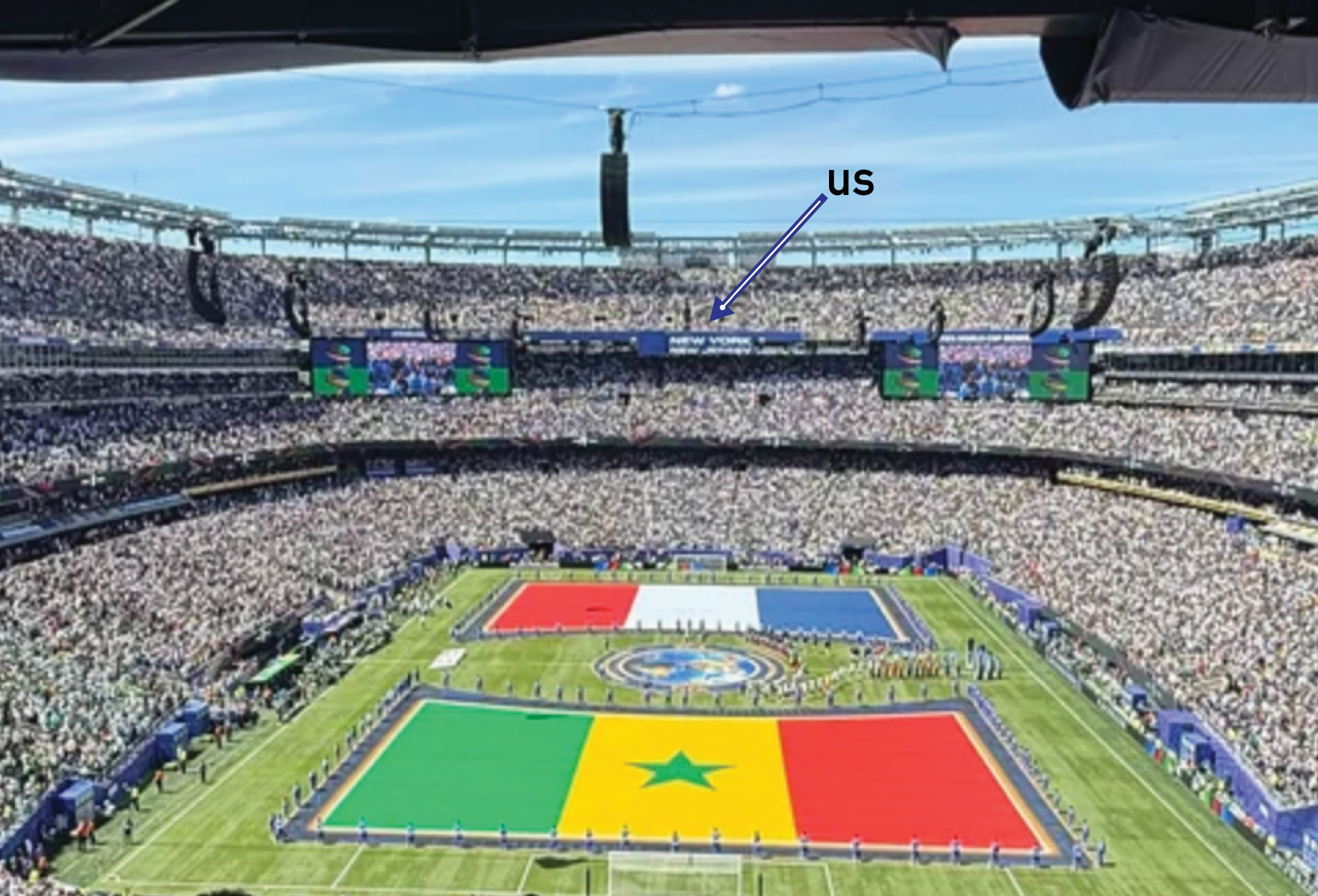
We entered the stadium through the main gift shop and after a few purchases, went by escalator to the 300 level. We were in our seats by 12:45, up high on the sunny end of the stadium behind one of the goals, an optimum vantage point for watching plays develop in either direction. It was nearly four hours since I left my apartment that morning, and over two hours before kickoff. The field had already been striped and the balls appeared to be inflated. But otherwise, perfect.
It would have been nice to settle into those seats until the pageantry started, but we didn’t want to be in the sun any more than necessary. We took a slow walk all the way around the 300 level, defining it as food option research. That killed a good 45 minutes. We got back to our section having each decided what lunch would be — tacos for me from a vendor a dozen gates around from ours, and for him, chicken fingers and fries from a counter just across from the taco cart.
From our walkaround and from scanning the stadium from our seats, we determined that attendees were around 70-75% French or French-leaning and maybe 10% Senegalese (more than I would have thought). The rest seemed to be like us — people who may favor one team or the other but who would have come to the match regardless who was playing. Along with French and Senegalese team apparel, we saw quite a few jerseys for Mexico and Colombia, as well as for professional teams from the Premier League, La Liga, and elsewhere.
And then there were the hats. All manner of eye-catching headwear. Caps, cowboy hats, sombreros. One topper was particularly popular among French fans. This. I know that when the site describes this as an adult hat, they’re referring to the size, but I found it funny (Adult? This?). And see the wavy strands of blue, red, and white threads? In person these hats looked a little ratty, like pet dogs had gotten a hold of them.
I didn’t see anyone among the French fans wearing a bleu de travail like mine. I got a few looks here and there (it really is quite blue), but their were no nods of admiration, and no one approached and addressed me in French.
Another noticeable element of the crowd: a significant number of pre-teen children. Lots of other dads and lads; quite a few moms and lads; groups of boys and girls together with someone’s mother or father as chaperone. I knew what he was thinking when he saw those kids: don’t take this for granted. Someone paid a lot of money for you to be here.
At sports events, he holds younger fans to a high standard. He’s visibly irritated when they don’t pay attention to the game, or make uninformed comments, or are loud for loudness’s sake. In our seats, I saw him cast a wary eye around at a couple of kids near us. But the 10-year old next to me — in a Colombia jersey that matched his dad’s — was locked in to the game throughout. The boy in front of us wasn’t, but at least he was quiet. At one point early, that boy’s mom poured a little water over his head to cool him off. Whenever her attention drifted away from him too long, toward the field or into her phone, he’d ask her to do it again. That went on until they left, about ten minutes before the end of the match.
A half-hour before kickoff, we went for food. Before walking away from me in my taco line to get in a line of his own, he pointed to a place just past the nearest gate and said it was where we should meet. I was exactly where I’d been told to be when he rejoined me with his chicken and fries. We ate in our seats.
________________
The Match
I’m not the kind of sports fan that instinctively roots for the underdog. Sometimes I do, but I also want to watch a good team play well and resent it when they don’t. So as much as I appreciated Senegal’s presence in the match, I was hoping the French team would look like a tournament favorite. My jacket may have indicated a preference for France, but if they slopped it up and Senegal made them pay for it, I was ready to switch my allegiance.
In the first half, Senegal was the more composed and fluid team but wasn’t especially threatening, while France looked like a few of their players hadn’t met yet. The action intensified quickly after the break. France’s superstar Kylian MBappe, well rested having not done much in the first half, had several point blank chances denied just after the restart. The Senegalese keeper seemed capable of matching the heroics of another small African country’s goal protector, Cape Verde’s Vozinho, who’d held mighty Spain scoreless the day before.
But Senegal could only do so much against MBappe. A quick pass into him posting up in the box, a don’t-blink spin and a shot, and it was 1-0. He added another one near the end of second half stoppage time, a blistering upper 90 effort from outside the box that made the final score 3-1.
But the goal that made it 2-0 France — that was the highlight for me. Because my son’s coaching brought it about.
The play started in the French half, with center mid Rabiot taking control of a deflected pass and pushing the counter. He had two runners on the left, MBappe and Barcola, both covered, with the other side of the field empty. As Rabiot passed midfield, my son pointed to the inside runner and said quietly, “Go right.”
It was as if Barcola heard him. He immediately angled to the open space, took a perfectly spotted pass, caught the keeper shifting over to confront him, and put the ball in the opposite bottom corner of the net.
Good call, son.
________________
…And Back Again
We took our time getting to the ground level after the match ended, then moved easily into the crowd heading back to the train. Again, his hand never left my shoulder. At one point the flow divided into wide lanes for either boarding the train or going into the American Dream Mall. With a light touch and no words, he directed me to where we needed to be.
The train was there, ready to be loaded. We were held up by a barrier just outside the platform for a bit. Then a large New Jersey Transit fellow on the other side of the barrier waved his arms and shouted, “Count it down with me! Ten! Nine! Eight!”
At “zero” he stepped back and opened the barrier. There was no running-of-the-bulls rush. Passengers quickly but calmly made their way onto the platform and down toward the front of the train. Once a car was considered to be loaded, the car behind it became available. Just as we reached the rear of the third car, its doors opened. We darted in, went to the top level, and had our pick of seats. It was 5:45. At 5:55, the train pulled out. Twelve minutes later, we were in Secaucus, where everyone had to change to another train. At the divide where passengers going to Penn Station were guided to the left, we were among the few who veered to the right.
At Hoboken, both New York-bound PATH trains were accepting passengers. The 33rd Street train was leaving four minutes sooner but I never considered taking it. That would have ended our day four minutes too soon. We took the World Trade Center PATH and were walking across the lower level of the Oculus a little after 6:30. We parted at Fulton Station, me to get the Number 4 train uptown, him to exit to the street.
I was at Molly’s with my wife well under two hours after the end of the match. People who haven’t traveled to and from events at the Meadowlands by public transportation may not realize just how remarkable that was.
She asked, “Well, how was it?” and after a rushed recap of the day, she asked, “Weren’t you hot in that jacket?”
________________
Attendance
Of the 80,000 plus attendees to the match, around 26,000 went to the Meadowlands by train, and another 15,000 went by bus. I would have guessed quite a bit less by the former and a lot more by the latter. About 6,000 went by ride share and the American Dream Mall provided parking for up to 4,500 cars (at the price of $250 per car). If you assume there were multiple passengers per vehicle for each of those options, it would get you close to the reported attendance. I did read about matchgoers finding alternative ways to the event. Apparently, some figured out how to get within a couple of miles of the stadium by a regular New Jersey Transit bus and walked from there.
________________
Conclusion
Other than a few more strategically placed clouds, I can’t think of anything that would have made the day better. The match was entertaining, the tacos were very good, and I was showing no signs of sunburn.
But with all of the high points of our World Cup experience, the most joyous moment of the event for me didn’t happen on match day. It happened the night before. It was his response to my response to the news that we were going, as I made sure he understood the magnitude of what he’d done. I raved and laughed and hugged, and when it got quiet, laughed and hugged all over again. And we made The Plan and secured the train tickets and I laughed and hugged again. And again. To see that proud, face-wide smile of his bloom again and again.
There’s a phrase I’ve heard used to describe how things change over time: gradually, then all at once. I used to think it was said by Darwin or some other scientist to describe the process of evolution. I’ve heard it in other contexts as well. But I now know it’s a slight rewording of a line in Hemingway’s The Sun Also Rises. One character is asked how he’d managed to squander his fortune and his response is, “Gradually, then suddenly.”
And that is a good description of what it’s been like watching my son over the years, determined to mark every milestone, to not to miss a thing and yet constantly being shown that I had, missed emergence after emergence as they were happening, only to catch on once the emergences were complete. For example, at some point we had to have been the same height. I don’t remember noticing that. There was only the later realization that he’d surpassed my height some time ago and was now tall enough to comfortably drop his hand on my shoulder.
That night before the match when I learned we were going, that day of the match where I was under his care: they weren’t moments of change. They were moments to celebrate that something already had changed. That what I hoped would happen one day had already happened. I saw it in his face. I saw it in him.
Just look at him. Look who he’s become!