
The Movie
I’m going to begin at the end here, with me at home late in the afternoon, after having been out in the 90+ degree heat for hours, now stretched out with an extra large cup of heavily iced water, blinds closed, and the air conditioner on for the first time this year.
I was watching the delightful Jim Jarmusch movie, Paterson, starring Adam Driver. He plays Paterson, a bus driver in Paterson, New Jersey, who spends his free time writing poetry, an endeavor that’s all-in supported by his loving wife, who has creative aspirations of her own. The third member of the family is a comically obstinate bulldog, Marvin, clearly more hers than his. Nellie, the female who played Marvin, gives, without question, the finest animal performance in the history of film. Think I’m calling it that just because I’m partial to bulldogs? Ha! She earned the prestigious Palm Dog award at the 2016 Cannes Film Festival. Posthumously, I now learn. RIP, Nellie.
The reason I’m starting with re-watching Paterson is that I’d just returned from Paterson, New Jersey, and it was this movie that intrigued me about going there in the first place, especially to see the Great Falls, a waterfall system in the Passaic River that flows through the city. Paterson (the bus driver played by Driver) goes to a favorite viewing spot by the falls on his midday break to eat from his classic lunch box (thermos in the rounded lid) and to write.
The movie also raised my interest in the acclaimed American poet, William Carlos Williams, a New Jersey doctor who wrote, among many other works, a book-length poem entitled Paterson. In the author’s note for the poem, Williams writes, “A man in himself is a city, beginning, seeking, achieving and concluding life in ways which the various aspects of the city may embody.” Considering that Williams devoted a book’s worth of poetry to Paterson, I made the understandable mistake of thinking he lived there. But no, he was a life-long resident of Rutherford, about 10 miles to the southeast of Paterson, further down the Passaic River.
Two more things about the movie Paterson. The story unfolds beautifully but there’s no melodrama or suspense or amped-up action here, no raised voices or slapstick hijinks. It’s low-key, observant, and soulful, reflective of its hero. I’d understand if viewers found it slow and uneventful. I didn’t.
The other thing I’ll add is that it has a terrific tip of the hat from one filmmaker to another. At one point on the bus, the camera flows away from Paterson in the driver’s seat to a couple of teenage passengers. They are discussing Gaetano Bresci, the Italian anarchist who lived in Paterson before going home to assassinate King Umberto I. The student characters aren’t given names but they are portrayed by the same actors who played the pre-teen runaways in Wes Anderson’s Moonrise Kingdom (also delightful). The Maine-based Moonrise was released in 2012, which meant that four years later those two were still together! Still are, as far as I’m concerned.
As to what might have brought them to Paterson, New Jersey, I don’t know. They are relaxed in the bus like they know where they’re going, not tense and wary like fugitives with families still trying to chase them down and keep them apart. Maybe they’d run off again and thought Paterson would be a good place to lay low.
___________________
The Trip
To get to Paterson from Penn Station, you pick one of several New Jersey trains to take you one stop to Secaucus. There, you transfer to the Morris & Essex Line for another 25-minute ride. If the timing works out and you get to Secaucus close to an M & E departure, the total trip takes well under an hour. If you just miss an M & E, as I did, you’ll have as much as an additional hour tacked on, the wait for the next train being much the longest part of the journey.
But as layover regional train stations go, Secaucus Junction is pretty great. It has a spacious and airy central atrium, naturally lit through a glass rotunda 150 feet up. There were good drink and snack options and a clean restroom. And I had a long but involving book from the library on my phone (The Keeper by Tana French). So I spent the time reading and looking around. Banners around the atrium celebrated recent inductees into the New Jersey Hall of Fame. I should have written their names down. The only one I remember is Connie Chung.
The Paterson train station would be more accurately described as a “stop.” There was no quaint little brick building with a barred ticket window, no wooden benches or musty vending machines. There’s one central platform for trains going either way, 20 or so feet above the intersection of a couple of avenues.
According to Google, my walk from the station to the falls was going to take 18 minutes. A couple of blocks in and I was on Main Street at the edge of downtown. There was a “Welcome to Paterson” sign with arrows indicating that I was going the right way to get to the Great Falls and the Historic District. It made me think I was about to walk through a sequence of quaintly preserved blocks.
But downtown Paterson isn’t like that. Honestly, it looked pretty worn out, reminding me of other places I’d seen where economic forces pulled the city away from Main Street instead of toward it. Paterson City Hall is a standout, an elegant example of late 19th-century Beaux Arts architecture, but it looks much fresher than anything around it. I passed store after store (furniture, clothing, household goods) with signage and inventory that looked like neither had changed much since the 1970s.
I’m sure the unkind weather was making everyone more sluggish and irritable than they would have been otherwise. It was already over 90, so hot it wasn’t surprising that no one talked about how hot it was. People waiting at the bus stops were backed up under the thin awnings of the storefronts to get what little shade they could. There were some appealing restaurants sending out the heavy complex aromas of Latin American food, but carried by that boiling air, those smells weren’t nearly as tempting as I usually find them to be. And in each block there was at least one person down on the sidewalk, sprawled out or propped up against a wall, some with paper-bagged bottles, most responding to affronts no one else could see or hear.
___________________

The Falls
The entire 80-mile course of the Passaic River flows within what was once the homelands of the Lenai Lenape Indians, and according to the official Paterson city website, the waterfall system I was there to see was a popular travel destination even then.
In 1791, a group led by Alexander Hamilton sought to capitalize on the falls’ potential as a power source for mills and factories. They founded the Society for Establishing Useful Manufactures (S.U.M.), a state-chartered private enterprise that would control the commercial development of the area.
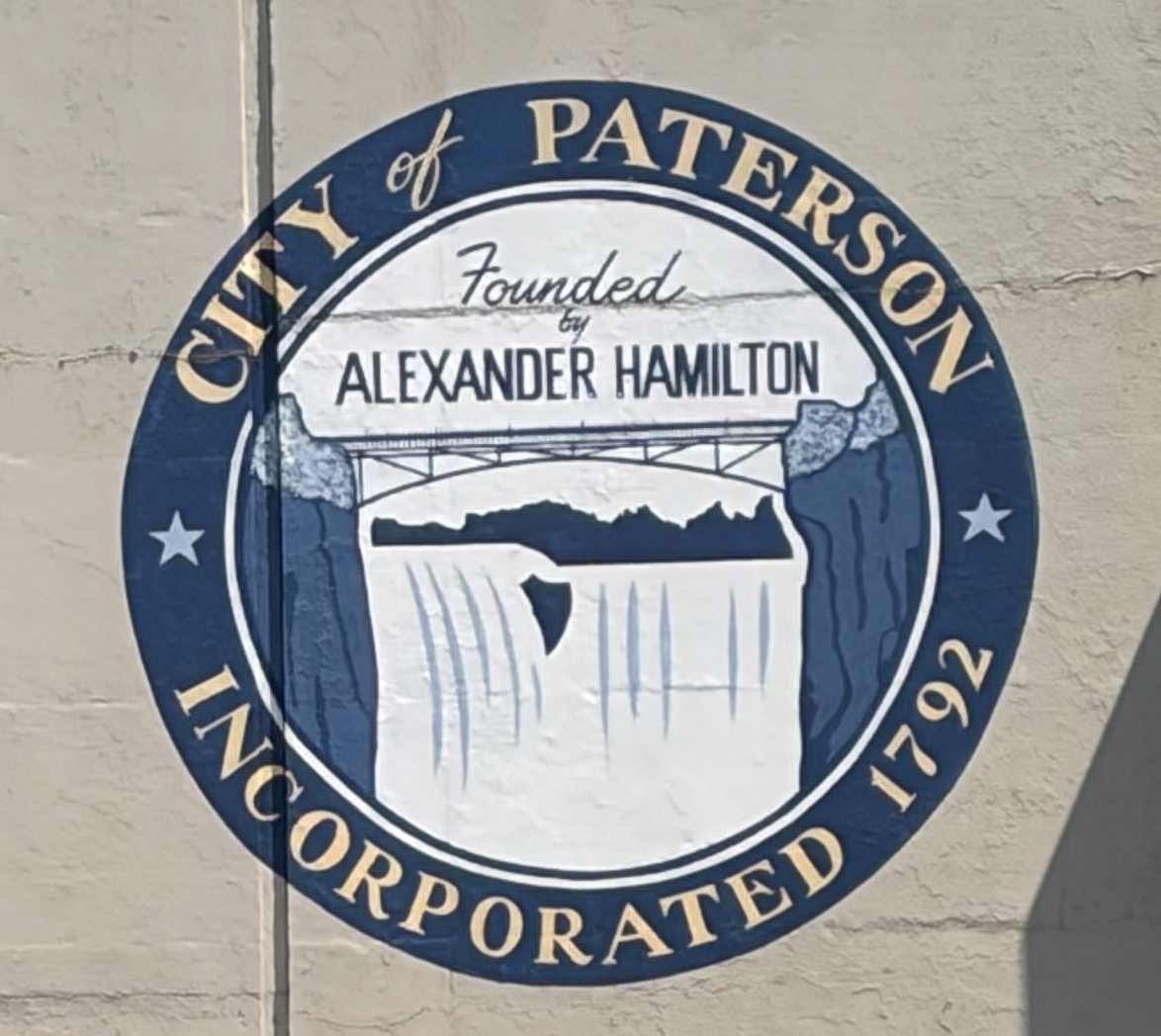
In 1792, Paterson was incorporated as the nation’s first planned industrial city. It was named for William Paterson, a signer of the U.S. Constitution and the governor of New Jersey who approved the S.U.M. charter. But the city embraces Hamilton as its true founder. I came across several signs in different locations across the city stating that, and there’s a statue of him in Overlook Park, the southern access point to the falls. There’s no outdoor statue of William Paterson anywhere in the city, although there is a bronze portrait of him, as well as of Hamilton, inside City Hall. Perhaps the S.U.M. offered to name the city after the governor to smooth the way for the charter.
Ultimately though, Hamilton would come out ahead on eponymous New Jersey towns. There are three separate municipalities on the state map named for him.
Initially, S.U.M. factories manufactured cotton and paper, but by the 1880s, Paterson was known as “Silk City.” Other “useful manufactures” produced over the society’s century-and-a-half run include steel, munitions, steam locomotives, aircraft engines, and early submarine models, which were tested in the Passaic River. But eventually the city’s industrial prominence declined. The “private” part of its public/private partnership ended in 1945, when the city of Paterson purchased the society’s charter and properties.
___________________
Overlook Park was built in 1964 and was most recently refreshed in 2018. I arrived there a little ahead of the Google time estimate and looked over the map, but you don’t need a lot of guidance. The area around the falls covers just a few acres, and there isn’t a complex network of trails to navigate. It’s a single concrete pathway that takes you through, and there’s not much chance of getting lost.
I walked along Spruce Street over the river and around the hydroelectric plant, which was built in 1914, decommissioned in 1969, then thoroughly re-engineered and reopened in 1986. To my left, the Passaic flowed under the Wayne Avenue Bridge, then spilled over a dam that sped the water along to increase its power. To my right, I saw the smaller of the two sections of the falls, but the sound made it clear there was a bigger one beyond it. Below, in front of the plant, a young couple sat on the bench where Paterson the bus driver ate his lunch and wrote poetry. You can walk down to that spot, but there’s no outlet to go further along at river level, so I stayed up top.
I saw no other visitors approaching from any direction when I began, no other day trippers or tours or school groups. And I realized it had been that way since I got to Paterson. I wasn’t the only one to get off the train there, but in hindsight, I think I was the only one using a phone for directions, and as I made my way through town, I hadn’t sensed that anyone else was headed to the same destination either ahead of or behind me. The falls may have been a tourist magnet for centuries but that day, it was just me and the playful couple on the bench below, who may have gone down there because they thought no one else would be around.
___________________
Mary Ellen Kramer Park, the section of the historic area surrounding the falls, was restored and re-dedicated in 2015. Mary Ellen, who died in 1993, was the wife of longtime Paterson mayor Lawrence (Pat) Kramer, and a tireless campaigner for preserving the historic district.
At first glance, it looked like the entrance to the park was fenced off and I was going to have to walk all the way around on the street to get in from the other side. But there was a gate in the fence and it was unlocked and open. I later learned that the park had only been accessible from Spruce Street since February 2026 when the restoration of the footbridge over the river a short distance ahead was completed — yet another recent upgrade.
I’ve seen plenty of pictures that give the impression that the falls are deep into a wilderness, a long winding hike from a parking lot. But in just a few minutes, I was across that footbridge and standing directly in front of the widest part of the falls. Google marks that spot with a purple camera icon — a prime photo-op. I’d argue that there’s better picture-taking from Spruce Street and that footbridge, where you can see the entire waterfall system, and the river briefly flowing back toward you before it kinks around to continue on its way through town. The photos that make the falls look like they’re in a much larger park were shot from those locations.
But that Google spot is the best place to experience the falls, to feel and hear them, humblingly powerful and loud. And close! At that point the chasm is so narrow that really stupid people might think they could jump across it. I hung out there for awhile, taking pictures and videos, but mostly just watching and listening, phone camera put away. I couldn’t lean out far enough to follow the water all the way down but I could see where the sunlight on the spray produced a faint rainbow.
Eventually other people did show up. At one point a family of four walked up and shot some photos, but they moved on before I could offer to take a picture with all of them in it. I couldn’t hear them clearly but I don’t think they were speaking English. There were a few others on the pathway walking in either direction, but it looked like they were out to get their steps in, not stand in awe of a natural wonder. They barely acknowledged the falls. I guess that can happen if you’re around them all the time.
On my way out, I passed a couple of side pools where it looked like the water had never moved, could never move — dead still, insect-swarmed, plant-choked. But the calming roar of the water was still there behind me, all the way to the end of the path.
There isn’t a bookend counterpart to Overlook Park at the northern end of the site, no introductory information for people going to the falls from that direction. The trail just kind of ends by a couple of small brick buildings. Once there, I checked my phone to get a walking route to the other historic Paterson site I came to see.
Turns out it was right in front of me.
___________________

The Stadium
Hinchliffe Stadium was built in 1932 and is one of the last remaining ballparks that served as a home to Negro Leagues baseball teams. Both the New York Black Yankees and the New York Cubans played there. Segregation and discriminatory lease agreements kept them out of Yankee Stadium or the Polo Grounds.
After falling into disrepair and nearly being demolished, Hinchcliffe was saved with a $100 million-dollar restoration project that also provided a preschool, a restaurant and event space, parking, affordable senior housing, and a museum. It officially reopened in 2023. The Art Deco facade is again brilliantly white, the facilities modernized, the seating stabilized. The field inside was converted to turf, and can now be used for soccer and football as well as baseball.
Coming from the falls put me at the deep right center field curve of the stadium. I stopped to take a photo of the stadium sign and its historical marker, and was surprised to hear an announcer’s voice coming from inside the park (“Now batting, third base, number 55, Felix Stevens….”). What a nifty touch, I thought, broadcasting the voice of an old-school ballpark announcer to add to the historic atmosphere of the place.
There were a couple of security officers positioned in front of an open gate in front of me. The stadium’s museum was directly above them on the upper level. I took a step toward the officers to ask about getting inside, then heard a car horn behind me and turned to see a Paterson police officer in his cruiser waving me over. He told me I couldn’t go in that way because there was a game in progress. Wait, those announcements were for a live game, happening right then? It wasn’t even noon yet.
I asked if there was an open gate where I could buy a ticket (really how much could it be?). He pointed up the street and said there was a box office around the corner.
I thanked him and walked alongside the stadium toward the intersection, where a street sign informed me I was on Larry Doby Way. Larry Doby! The second African American in Major League Baseball after Jackie Robinson, and the first to play in the American League (Cleveland)! He’s from Paterson! I later learned that the design of his Congressional Gold Medal includes an embossed representation of Hinchcliffe Stadium. He wasn’t a member of the Black Yankees or Cubans but his first professional team, the Newark Eagles, discovered him at a tryout at Hinchcliffe.
There was a box office at the corner gate that would have put me in the stadium near the right field foul pole but it was closed. Next to one of its ticket windows there was a poster setting out pricing and seating options for matches to be played by the New York Cosmos. The legendary soccer team! The Cosmos began playing in the New York area in 1971, and count among their former team members an aging but still effective Pele. He was with them for three seasons, on the pitch for 64 matches and scoring 37 goals. He led the team to two league championships. His final professional goal came on October 1, 1977, a 30-yard free kick in a nationally televised exhibition match in a sold-out Giants Stadium against his longtime Brazilian club, Santos.
The original Cosmos ceased operations in 1985 when the North American Soccer League folded. The current version of the team is in its inaugural season in the third-level USL League One, the second attempt since 2020 to resurrect the franchise. And Hinchcliffe is now their home. Team banners lined the facade of the stadium, including one with Pele’s name and jersey number (10) on it.
The box office at the home plate entrance was also closed, but the gate was wide open. Apparently, admission for that day’s contest was free. A security guard sat in a folding chair against the wall, in a triangle of shade barely long enough to protect her. She was bantering with another guard, a young man. When she saw me waiting at the metal detector she encouraged me to come in with a smile and a wave, without interrupting her conversation.
There really was a live baseball game in progress and it wasn’t high school or Little League. Paterson’s Jersey Jackals were taking on the Sussex County Miners, a “Battle of New Jersey” rivalry clash. The teams compete in the Frontier League, an official Major League Baseball partner and the oldest active independent professional baseball league in North America. It wasn’t yet noon, but the game was already in the fifth inning!
At capacity, Hinchcliffe can host about 7,800 spectators, but there were less than a hundred in attendance, and it seemed like everyone else there besides me was part of a school trip — students, teachers, chaperones. It was murderously hot, and the stadium offered very little shade except in certain corners by the stairways or in the restrooms, which, to my relief, were open. Industrial strength fans were deployed around the stadium, spraying mist to cool the air. They got more attention from the attendees than the concession stand or the game itself.
The Jackals were up 3-0 and they added a run while I walked around inside the stadium to the museum, which was nicely done, with attractive and informative exhibits. I would have lingered over the displays more but I’d arrived just behind a swarm of school kids and their overmatched teachers. A young man at the admissions desk (card table) greeted me by saying, “Welcome to chaos! They never tell us about these field trips until they are on the way.”
I did stay long enough to learn more about Larry Doby, the teams that used to call this stadium home, and the many famous Negro Leaguers and future Major Leaguers who played there. Seventeen of the 37 Hall of Famers inducted into Cooperstown with ties to the Negro Leagues played games at Hinchcliffe, including Satchel Paige, Roy Campanella, Josh Gibson, “Cool Papa” Bell, and Monte Irvin.
An unexpected highlight of the museum was a vintage open-cab midget racing car. In the 1930s, Hinchcliffe Stadium hosted motorcycle and automobile races as well as stunt exhibitions by John Kochman’s Hell Drivers. The popularity of racing in the stadium led to the development of Paterson’s nearby Gasoline Alley, a concentration of auto repair shops where drivers came to modify their vehicles.
After the museum, I walked back around the top of the bleachers, and took some pictures with a behind-the-plate view. Between the harsh sun shimmering off the turf and the disorienting first-thing-in-the-morning start, I couldn’t imagine how the players could even see the ball. But both teams played error-free while I was there. And I was reminded how loud a hit off the bat sounds with no crowd noise to absorb it. Pretty jarring.
I’d considered calling a taxi or a Lyft to get me from the stadium back to the train station, but I checked the New Jersey Transit schedule and had plenty of time until the next Secaucus-bound departure. At 1:12 pm, I was seated on a bench in the shade on the elevated platform, with a fresh bottle of water and my library book opened on my phone, waiting for the 1:29 to start me on my way back to New York.
___________________
Epilogue
Once home, I did some more digging into the Jersey Jackals. It turns out that a 10:35 am first pitch wasn’t uncommon for them. Many more games on their schedule were set to start mid-morning including the two remaining contests in the current series with Sussex County. I assume the Miners went home every day rather than stay in Paterson. Augusta is only an hour away.
I also learned that while jackals aren’t native to New Jersey, mining very much is. Sussex County itself is home to the now-closed Sterling Hill Mine and the still-operational Franklin Furnace, each a zinc orebody with high concentrations of hundreds of other minerals as well.
The next thing I learned is that somehow, I’d misread the scoreboard. I could have sworn it was the Jackals who were ahead 4-0 when I left, but it was the Miners. Not sure how I could have gotten that wrong. In my defense, there wasn’t a lot of help from the miniscule, utterly disengaged crowd, no timely organized cheers expressing appreciation for hits or outs. Sussex County wasn’t able to hold on to the shutout but they ultimately won 4-3.
Next, I learned that Larry Doby and William Carlos Williams aren’t the only 20th-century American cultural icons from Paterson. There’s also poet Alan Ginsberg, boxer Hurricane Carter, former New York Giants great Victor Cruz, and actors Jason Alexander and Richard Kind. And speaking of baseball, Lou Costello! There’s a statue of him in Lou Costello Park, not far from the falls, and the city pool in the recent extension of the historic district bears his name as well. I wish I’d known that. It wouldn’t have taken much time to swing by.
I also regretted not making time for the Paterson Museum. Between the falls and the stadium, I learned a good deal of Paterson history, but the museum would have put it all together, from the Lenape to Lou Costello to the present. And it would have offered some relief from the hammering cloudless sun, which had worn me out.
Finally, be warned!
I can’t advocate strongly enough for the movie, Paterson, but the Amazon Prime version deletes an essential moment. Every day when Paterson the bus driver/poet comes home from work, he has to stop and straighten up his mailbox. But the scene that reveals how that knockover keeps happening is missing! Just flat out not there! Outrageous! I was so upset by this I got a DVD of the movie from the library, not just to confirm where the scene should be but to enjoy that payoff all over again. Then I decided to try to do something about it.
Jim Jarmusch does not maintain a social media profile (not surprised) and doesn’t have a production company website with a dump-off email address monitored by an assistant. The best I could do was to identify the agency who represents him (I think). I sent a message about the deleted scene to him through the agency’s LinkedIn page. I’m not counting on getting a response but it felt good to do something.