
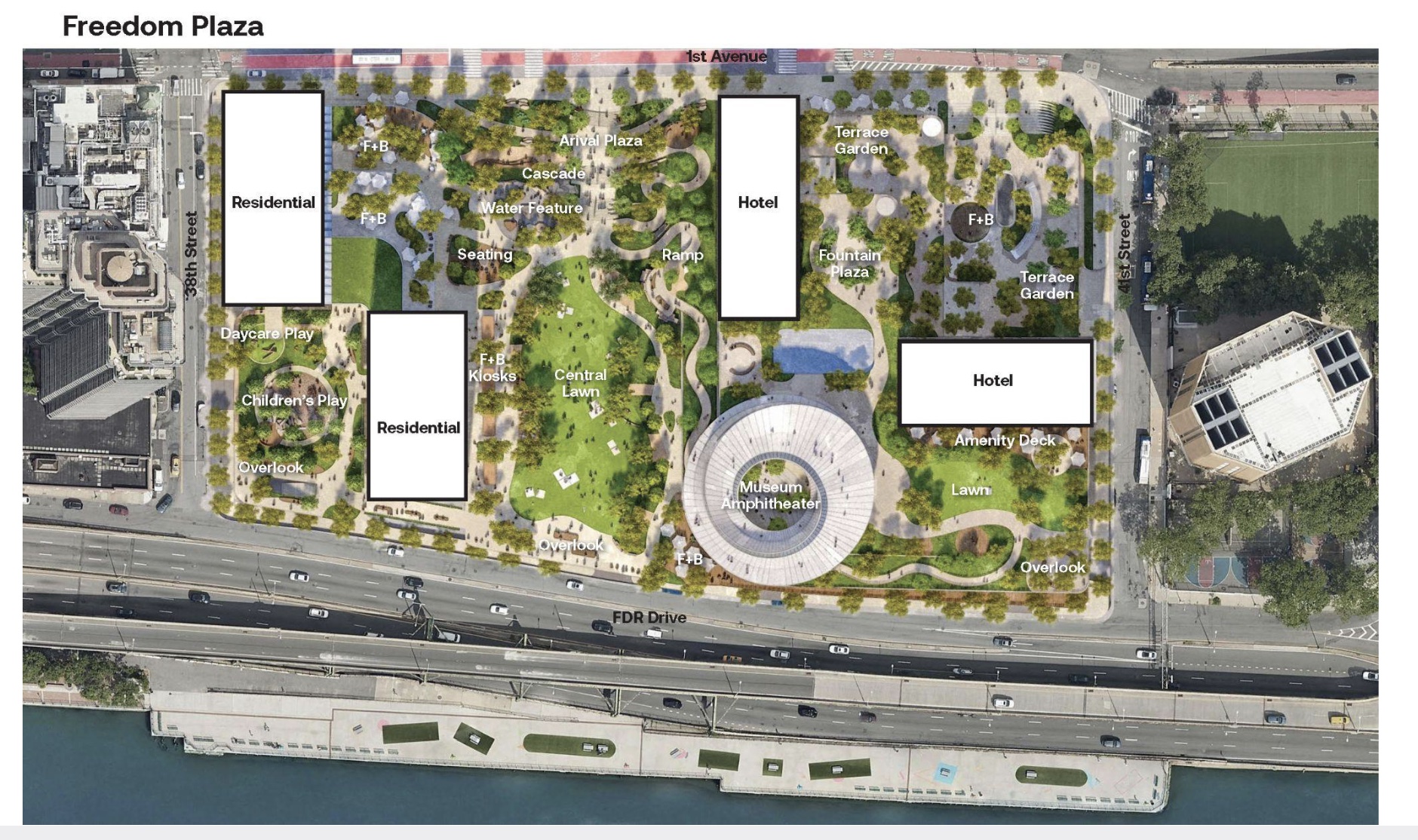
This the first of a four-part series on residential/.commercial complex proposed for a undeveloped site on the east side of Manhattan. If realized, it would be one of the largest projects of its kind in New York — and it would include something Manhattan has never had.
The Site
Just south of the UN on First Avenue, a few blocks from where I live, there is a rare sight for Manhattan: a large parcel of land that has remained undeveloped for over 20 years.
A Consolidation Edison generating station operated there from 1901 until 2005, when the station was decommissioned and torn down. Prior to that going back into the 19th century, the site was part of a larger area of tenements and slaughterhouses.
At the time the ConEd station came down, the land was owned by billionaire New York real estate developer Sheldon W. Solow. Plans were announced to construct seven luxury apartment towers at that location, of up to 70 stories in height. There would also be landscaped park with public access. The project faced some community pushback but the aim was to get Solow to scale back the size of the towers, not to stop the construction altogether. A modified version of the plan, with the height of towers cut significantly, was approved by the New York City Council in March, 2008.
But the project never got to the trucks-and-backhoes stage. The initial hurdle to clear: after a century of industrial use, the land was so thoroughly soaked with toxic waste that the EPA designated it a “brownfield.” Before anything could be built there, the new owners had to clean it up (Solow reported that the cost of doing so was around $100 million).
_____________________
The Developer
The man now in control of the site is Stefan Soloviev,, Sheldon Solow’s only son. Theirs was a contentious relationship. Solow had earned a reputation in New York real estate circles as being difficult and unpleasant, and Stefan seems to have felt that way about him as well. By some accounts, he chafed at being labelled the “heir apparent.” Instead of staying in New York to be groomed to take over the business, Stefan headed west, initially to Arizona, to build an entrepreneurial life independent of his father. He also changed his last name from the Anglecized “Solow” to the original Russian name of his bricklayer grandfather: Soloviev.
But in 2018, control of the Solow Group did indeed pass from the 89-year old father to his 46-year old son. Solow died three years later. After taking his father’s place, Stefan consolidated all of his interests under a new holding company, using the original Russian name for that as well.
Soloviev is the reason the company has such vast holdings outside of New York. According to their website, the Soloviev Group’s portfolio includes staggeringly large interests in agribusiness, transportation and railroads, renewable energy, hospitality, and logistics. In an admiring profile in The Land Report, other Western landowners and business leaders portray Soloviev as an innovative and gifted land owner and businessman, a good partner and a good neighbor, an unlikely but committed Midwesterner and Westerner.
As for his standing among the New York real estate elite when he took control of the Soloviev Group, Stefan didn’t have the reputation for difficulty as his father had, but he was considered an outsider, unproven and unknown. Not anymore. Working with his Manhattan-based CEO, Michael Hershman, he’s been as adept a businessman in New York as out west, increasing occupancy rates and profitability of Soloviev’s real estate portfolio.
And now comes his boldest move. What the Soloviev Group is currently proposing for the First Avenue site is a substantially enhanced version of the original plan. It would be one of the largest, most expensive developments ever in Manhattan (estimated price tag: 11 billion dollars). The project is called Freedom Plaza. Both Google Maps and Apple Maps have accepted this. Use “Freedom Plaza” as a search term and you’ll be taken to the spot. (One United Nations Park, a 42-story luxury apartment complex across the street from Freedom Plaza was also built by Soloviev.)
If realized, Freedom Plaza would be a stunning achievement for someone who for decades showed little interest in his father’s real estate company. It would also be a remarkable makeover for what is now the largest patch of weeds in midtown Manhattan.
_____________________
The Owner’s Meeting
I first heard about the proposal for Freedom Plaza on June 16 of this year, at a unit owners’ meeting at our apartment complex, Kips Bay Towers. The guest that night was our outgoing city councilman, Keith Powers (leaving office due to term limits). It was clear that our board of directors knew him well. In introducing him, our President listed a number of good things the council member had helped make happen and a few bad things he helped prevent. Powers made sure we knew he’d grown up in the neighborhood and had always had friends in our complex. But it would be the only time (as far as I could recall) that he joined us in his capacity as our most direct voice in city government.
At the meeting, my fellow owners were almost uniformly against the development of Freedom Plaza. But for the most part, it wasn’t the plan as a whole that concerned them. Just one specific aspect of it, and if you look at Soloviev’s web page and social media campaign for the project that pivotal component won’t immediately be obvious. Posts from Soloviev or other sources in favor of Freedom Plaza emphasize such attractive benefits as a beautifully landscaped public park along the waterfront, a hotel, two apartment towers with a considerable percentage of affordable units, a Museum of Democracy, and a variety of dining and entertainment venues. At one point, there was to be a Ferris Wheel in the center of it all, but that’s been scrapped.
Along with those amenities, the campaign touts the economic benefits of the project and insists that unions and spiritual leaders were strongly supportive of it. What was in it for spiritual leaders I didn’t immediately understand, but the appeal for the unions was obvious: lots of jobs during construction, and plenty of permanent jobs once everything was up and running. Including quite a few jobs at the attraction that so many of my fellow residents found objectionable.
The casino.
Partnering with the Mohegan tribe (which operates a number of other gaming and hospitality venues), the Soloviev Group proposed putting a “subterranean casino” in Freedom Plaza — 295,000 square feet of gaming, including 5,700 slot machines. It would be tucked underneath the far northeast corner of the lot just off the access road from the FDR, gleamingly elegant in the renderings yet undetectable from above (in some overhead representations of the site, there is no indication of a casino at all.)
Soloview was vying for one of three “downstate” licenses made available by the State of New York for fully operational casinos with live table games and a sports book.
A tourist-attracting, revenue-generating casino.
A boon for our culture- and entertainment-starved city.
Because, as we all know, New York City is curiously bereft of things to do and reasons to visit.
Right there, I’m mirroring a prevailing theme of the Kips Bay residents at our owners’ meeting: We’re Manhattan! We’re New York! What do we need a casino for?
Perhaps if our community was a few blocks closer to the proposed site, like Tudor City, there would have been more emphasis on a casino’s detrimental impact of neighborhood life and certainly those objections were raised (more crime, more traffic, more noise, more drugs, etc.) But that night with our resident owners, the prevailing objection was along the lines of, “We’re the greatest city in the world and we don’t need a casino to prove it.”
One person at the meeting did come out in favor of the project, citing the revenue, the jobs, the park, and the dining/entertainment options. It would be nice to have all that stuff. He spoke offhandedly and with a shrug, not agitated or argumentative. He didn’t endorse the casino itself but wasn’t concerned about it. He’s spoken at other meetings about other issues and tends to be a lone voice on whatever is being discussed.
Without trying to match the intensity of the opposition, our councilman assured us that he too was not in favor of the casino and would advocate against it. He also let us know that since Freedom Plaza is in his district, he would be appointing one member to the Community Advisory Committee that would be reviewing the license application. That appointee would be a resident of our complex.
I’ll add here that the development of Kips Bay Towers was itself controversial, sparking protests in its day. In the late 1950s, the city’s Commission on Slum Clearance (under the direction of Robert Moses) demolished over 100 small buildings to make room for this place, which consists of two sets of two apartment buildings with a large central garden connecting them. The city promised to relocate residents of the 10-square block area but never provided sufficient housing for them. Two decades after the complex opened there were more protests when the building closed off public access to the garden, making it exclusive to the residents.
_________________________
The Process
Here’s how we got to the point of potentially awarding a license for a Manhattan casino — and what happens next.
In 2013, the New York State constitution was amended to allow the state to issue seven casino licenses, including three for downstate locations (“downstate” meaning the five boroughs of New York City and bordering counties. Twelve years later, eight proposals are under review for those three downstate licenses:
— Plans to extend existing but limited gambling operations at racetracks in Yonkers and at Aqueduct in Queens to include table gaming and sports betting
— A proposal for a development at Bally’s Golf Links at Ferry Point in the Bronx (Bally’s purchase the lease for the course from the Trump Organization in 2023).
— A bid to include a casino in a large development plan for Coney Island
— A development from Hard Rock Hotels and backed by New York Mets owner Steven Cohen, to sit beside CitiField and The National Tennis Center
— Two other Manhattan-based proposals besides Freedom Plaza — one in Times Square (backed by Jay-Z) and one on the far west side of Midtown between Hudson Yards and the Javits Convention Center.
There was an additional proposal for a casino at Hudson Yards as well, but the developer dropped that bid during the summer, citing strong public opposition.
Any application must first be endorsed by a local Community Advisory Committee (CAC) appointed by various office holders to look at that specific bid only. If the CAC doesn’t advance the application, that’s it. If the CAC does advance the application, the next stop is the State Gaming Location Board, which will review all bids forwarded by the local CACs and can send as many of them as they want to the State Gaming Commission. The Gaming Commission will make the final call. It can award as many of the three available licenses as it deems appropriate, or none of them.
_________________________
The Path to Liberty
I’ve referred to the proposed Freedom Plaza site being as of yet undeveloped, but that’s not to say it’s empty.
In the winter of 2024, The Soloviev Foundation, the company’s philanthropic arm, installed the Field of Light, a walkthrough experience promising to immerse visitors in radiant colors provided by thousands of wands with glowing tips planted along a curving pathway. Field of Light was advertised with stunning photos and one could imagine how much more magical it would be to walk through it during the holidays, with a nip in the air, a little frost on the ground.
But those hypercolorful, clearly enhanced photos bore little relation to the reality of the Field of Light. The pale lights of those wands didn’t exactly pierce the night and the colors didn’t stray far from the blue/indigo band of the spectrum. Their impact was further diminished by the area’s rambunctious growth of grasses and weeds. The light wands may have been taller than the weeds when installed, but things didn’t stay that way.
So as transcendent experiences go, kind of a dud. When my family visited the site, we were so underwhelmed we didn’t even bother to go inside and get personally immersed in it. Looking at it through the fence along First Avenue got you about as much as you were going to get. I went by there several more times that winter and it never got any more colorful, and more light-ier.
Field of Light closed early in 2025, but that summer, The Soloviev Foundation introduced a new installation: The Path of Liberty. A Celebration of the Declaration of Independence, which the Foundation described as “an intimate look at what it means to be an American, told through large-scale portraits, stunning landscapes, and captivating interviews.”
A few weeks after learning about Freedom Plaza, I went by the site and saw that, indeed, something new was happening there. The fencing on the north, west, and south sides is wrapped in blue vinyl advertising the Path of Liberty with renderings, large photos, site maps, and the necessary permits on display. On the east side, along the FDR access road, the vinyl is green. Flagpoles were installed around the perimeter, each with a flag of one of the fifty U.S. states. The other side, the
On the day I stopped by to take a look, a security guard was posted on the corner of 41st and First Avenue. He was wearing a polo and chinos, both dark blue, not a law enforcement-style uniform. It was a warm day and the guard was tucked into a parabola of shade on that corner. He had no chair or table, no water that I could see. Just an umbrella. That shade wouldn’t always be there.
Like most construction sites in the city, the barrier is in place (vinyl or boarding) is as much an invitation to peek in as a warning to stay back. There were plenty of eye-high opportunities for seeing what was taking shape inside. The Path of Liberty was going to be another walkthrough experience. A series of 20-foot tall photo displays had been set up along the winding pathway left over from the Field of Light. Some of the photos were already in place, including a larger versions of images along the fence. I later learned there had been a groundbreaking event for Path to Liberty, featuring musician/actor Lenny Kravitz and Bo Dietl, the former police detective/private investigator and also an actor. He plays crime boss Thomas Lucchese on “Godfather of Harlem.”
They may have broken ground for The Path to Liberty, but momentum had clearly stalled. Despite the displays being in place, The Path wasn’t close to being finished. A sign on the First Avenue wall said the opening was to be Spring 2025, and some online sources offered the specific opening date as May 15, but May was long past. And despite it being a midweek early afternoon when I visited that first time, I didn’t see anyone working inside the site. Just that one security guard outside.
It was also clear that one of the key lessons from the Field of Light remained unlearned. No one had bothered to organize a thorough mowdown and clearing of the weeds. Those unruly plants weren’t going to swallow up the large image panels the way they did the anemic light wands but they had continued to grow. It made it seem like the recently installed displays had instead been in place for years, like the site was a dumping ground for abandoned miniature drive-in theater screens. Rather than giving you a glimpse of what the Path to Liberty and Freedom Plaza were going to become, the unfinished project made the site look even more like what it in fact was: a plot of land left fallow for nearly two decades.
Currently, the Path to Liberty website encourages visitors to reserve their timed tickets for dates later in the fall of 2025, but a click on the ticket link only gets you a popup screen thanking you for visiting Field of Light.
______________________
The Community Advisory Committee evaluating the Freedom Plaza casino license application held two public meetings before taking a vote. At those meetings, representatives from the Soloviev Group and Mohegan Sun presented their proposal, then supporters and opponents of the project were given the opportunity to voice their opinions (without addressing any questions or comments directly to Soloviev or Mohegan). Part Two of this project is my report on those meetings. I had to cover the initial meeting remotely but I made a point of attending the second, longer session in person. I wanted to witness democracy, New York style, firsthand. And I thought there might be drinks and snacks.