
“Are you retired?”
I get asked that fairly often these days. The short answer is “No.”
Sometimes I’m asked, “How are you enjoying retirement?” and sometimes I play along and explain how I fill my days. Sometimes I say, “When I retire, I’ll let you know.”
However it’s expressed, it’s a perfectly reasonable question. I’m of a certain age and not formally employed. So go ahead and ask, it’s fine. But maybe get a refill first. As many will attest, I rarely give a short answer to anything.
At this point in the first stage of writing this piece, I started going on and on about why I don’t consider myself retired. I then moved into a detailed examination of the pros and cons of growing older in New York City. This was the focus of my thinking on a recent walk from The Museum of the Moving Image (Astoria) to Kabab King (Jackson Heights), 40 minutes on a hot early summer afternoon.
I gave this topic a good going over as I made my way along Broadway (the Queens Broadway). At various times, I might have articulated some of my thoughts out loud, as if responding to an interviewer, but I was on a street busy with car and pedestrian traffic, and it was, after all, New York. I didn’t notice anyone being concerned. With my headphones on it might have looked like I was having a phone conversation, but I was listening to Massive Attack.
By the time I arrived at Kabab King (excellent), I had an essay’s worth of ideas fully formed and arranged into paragraphs — coherent, detailed thoughts on losing my last-ever job, the meaning of retirement, and the challenges of aging affordably in New York. The next morning I typed it up, right here, several pages worth.
Then deleted it.
Or rather, offloaded it to a separate file. I decided instead to focus on a better subject for this story, a man I deeply admired for the way he navigated the city in his later years.
Enter Clyde.
_________________
I met Clyde Robertson in the 37th floor copy room in our offices at 26th and Madison, maybe 2008ish. I can’t say I remember it like it was yesterday (honestly, I’m not 100% on yesterday), but it’s likely that I walked in to make some copies and found him sitting on a stool by one of the two machines, running a job or reading the New York Times.
Today, with networked printers, digital workflows, signable pdfs, etc., there’s not much call for a dedicated photocopyist. But at that time, our company ran a lot of paper through those machines, guided by hand, some tasks requiring multiple sets of multiple draft chapters of a textbook. For awhile, instead of tying up editorial and production people with that work, we had Clyde.
He was in his late 70s then, wiry, hair cut close on the sides but long enough on top to be parted, a small rooster tail spiking up in the back. He was shorter than me but not by much, always cheerful and chatty. I might have been among the first to meet him, or among the last, I don’t know. What I do know is that he went from somebody new to somebody everybody knew pretty quickly. And it was obvious that he enjoyed being there, in an office full of people, being useful instead of just sitting around.
I understand the appeal of that.
I didn’t need a lot of copying done and when I did it was just a few pages at a time, so I didn’t put Clyde to work very often. I’d only leave something for him to do if both machines were in use and I needed to get back to my office. But it wasn’t long before I began stopping in to chat, whether I had something to be copied or not.
This first time I was with Clyde outside of the office was at a loft in Tribeca, at a party he hosted. It was on the afternoon of July 3, after our noon release from work for the Independence Day holiday. There were spreads of chips and crackers and cheeses set up around the main room and the kitchen, along with a few bottles of wine, and Clyde was in constant motion, checking on everyone, refilling trays and glasses. I think there were a couple of other managers there, but as I remember it, most of the guests were assistants who he’d relieved of a significant amount of copy duty.
The loft was home to friends of Clyde’s who spent their Julys somewhere in France (that’s how Clyde described it with a hand wave. “Oh, somewhere in France.”). He was living there the whole month, with the overriding responsibility of taking care of the apartment’s astonishing volume and variety of plants (on every shelf, every window sill, every table and cabinet top, everywhere). Clyde was their go-to plant sitter.
It was only after that I learned he had another, more significant source of additional income (we didn’t have the term “side hustle” back then). In addition to being a plant sitter, Clyde was a cat sitter as well.
_________________
My wife and I had done a bit of cat-sitting ourselves in our younger days in the city, for a couple of couples who knew we’d happily look after Smokey or Chambertin with a weekend in a nice Manhattan apartment as an additional incentive.
At the same time, we were cat owners ourselves. Shug (named for Shug Avery in The Color Purple) was adopted from the main ASPCA center on East 92nd Street. Belle (from Beauty and the Beast) was acquired a year later from the Petmobile, a repurposed mobile home filled with ready-to-adopt kittens and puppies, with essentials like tags, collars, food, and litter boxes available as well. This particular Petmobile parked in the midtown office area and processed adoptions before work or at lunchtime. Adopters would stop by after work to claim their freshly vaccinated pets and whatever else they’d purchased.
At some point in Shug’s and Belle’s lives with us, we traded off cat care with the graphic designer on my staff. After she married and relocated back to Tennessee, we used a pet care service — until we had the disastrous experience of being indifferently cat-sat for. What a mess. Lesson learned: don’t pay in advance.
Then came Clyde and the great relief of again having someone I already liked and trusted available for our two. Shug and Belle were settled-in adult cats by then and he was a great match for them, not a “pop in, feed and scoop, pop out” type. He was more like a real baby sitter, prepared to stay awhile and become a familiar companion. He based his timing on the TV Guide. I once called him to check in and he reported that everything was just great. “We’re all on the couch watching Charade!”
By the way, as people familiar with The Color Purple know, Shug is pronounced like the first syllable of “sugar.” But for some reason, Clyde always called her “Shrug,” and said it with a little headshake and shrug of his own, like he couldn’t understand why anyone would give that name to a cat.
I learned a lot more about Clyde once the cat-sitting started and we could talk outside the office, not worried about someone impatiently waiting to put him to work. He told me he’d had a long career at the ad agency, J. Walter Thompson, retiring as head cashier. And he told me he’d been in the army, something he still seemed to find surprising himself.
He told me he’d shared a rent-controlled studio on 13th Street for over 20 years with a man he described as “not a boyfriend and not there a lot.” He told me he felt fortunate to have a good landlord because he really didn’t have any place else to go. And it came out that he’d made a thorough assessment of activities and discounts and free or inexpensive meals the city offered to senior citizens. Here’s how thorough: he told me there was one center that served a spaghetti lunch on Wednesday that was terrible. If he wanted spaghetti, he waited until Thursday and went to a different center that did it much better.
He had several other steady cat-sitting clients besides us, mostly work colleagues. One lived in Brooklyn. Most of the others, including us, were on the east side of Manhattan, conveniently walkable from the Freeman office or accessible by the M15 bus. We actually found ourselves riding that bus with him a couple of times as he was headed back downtown from a cat gig.
_________________
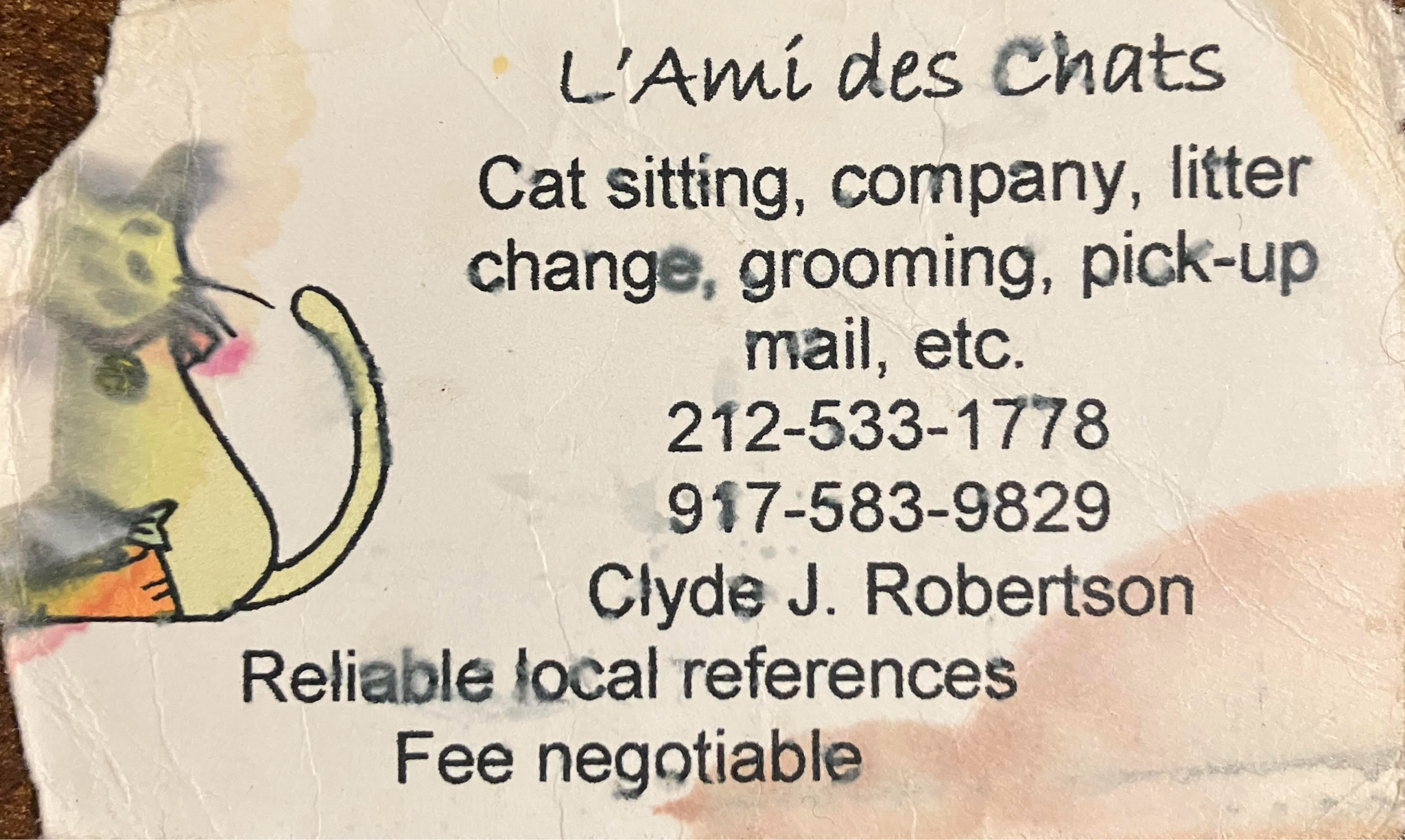
In preparing for this story, I reconnected with a former work colleague who was also a cat-sitting client of Clyde’s. The scan of his business card at the top of this story came from her. L’Ami des Chats! I have his card as well, around here somewhere. I know I’ll find it when I’m looking for something else. I can’t imagine I’d toss such a thing away.
In addition to the card, my colleague shared another key resource for this story: this article in the New York Times. And there he is! The article was published in February of 2012, after he’d left the copy room and both of our cats were gone. Otherwise, he would have told me about it himself. He would have told everyone about it.
The story is about a much-loved drop-in center in Chelsea run by the nonprofit group SAGE (Services and Advocacy for Gay, Lesbian, Bisexual and Transgender Elders). As you can see, Clyde was the face of the article, and not surprisingly to me, his take on the place has a lot to do with the food. He talks about going to the center regularly in the evening for dinner because the center closer to him closed at 5. The article mentions his time at J. Walter Thompson and his military service. He tells the reporter that he was proud of completing basic training because he was “considered a sissy back home.”
_________________
Shug and Belle died a year apart, each at 18, each of complications from diabetes and hyperthyroidism. Each underwent surgery and needed regular injections.
It started with Shug. We were away and Clyde came in to find her unconscious. He got her to the veterinarian’s seven blocks away and called us. I called Dr. Andy and he gave us the option of getting Shug treated or letting her go. If we’d been there and taken her in ourselves, we might have decided differently. Actually no, I don’t think we would have. Through our experience with Shug, we were able to recognize Belle’s symptoms early, and we made the same decision with her.
Each cat lasted another couple of years after initial treatment, and I don’t think we left them alone or with Clyde very often in that time. When I started this story, I had it in mind that Clyde cat sat for us for a number of years, but now I realize he only came to stay with Belle and Shug a handful of times.
_________________
I don’t remember which came first, our apartment being without cats or the office being without Clyde. I do remember the last time we found ourselves on the M15 with him. He had to have been over 80 by then, and we were no longer a client, but L’Amis des Chats was still in business and he was heading home from a job. He asked if we’d gotten new cats and I told him if we had, he would have known.
And then, over a decade later, on that walk in Queens, thinking about aging in the city, here he came back to mind.
_________________
I looked for Clyde on a site I used to research my ancestry, and found out a little bit more about him – his birth year, information about his parents and sisters. There’s a page of the 1950 census attached to his record that lists him as a boarder and a stockroom worker — in San Francisco. It has the right birth year and birthplace, so it’s the right Clyde. There isn’t any later documentation that places him in New York, nothing that gives an indication of when he came back. The site refers to him as deceased but doesn’t include a date and there’s no death certificate attached. If he is still alive, he’s 95.
I tried the 917 number on his business card but it’s no longer in service. I requested his military records but the National Archives responded that I didn’t have enough information about Clyde to proceed. I was also informed that even if I could provide more details, it’s likely his records would still be unavailable. A significant portion of the documents covering his likely dates of service were destroyed in a 1973 fire.
So there doesn’t appear to be a way of finding out where he was stationed, if he ever shipped out, or where San Francisco fits in his timeline. When that 1950 census was taken, Clyde was only 20 years old, too young to have served in the war that ended five years earlier — and thus too young to be among the surge of gay servicemen returning from the Pacific who chose to remain in San Francisco after being discharged. He could have been drafted when he was 18, assigned to a base in the Bay Area, and stayed after fulfilling his service. Or maybe he went west on his own and was called up from there.
It’s likely there are people in my social media sphere that knew Clyde, and knew him better than I did. If anyone has anything to share about him or if I got anything wrong, please email me at redhillconsultingservices@gmail.com. Or we can see if this page works. You’ll get full credit for any information you provide.
Until then, if anyone’s looking for a copy room attendant or a cat sitter…