
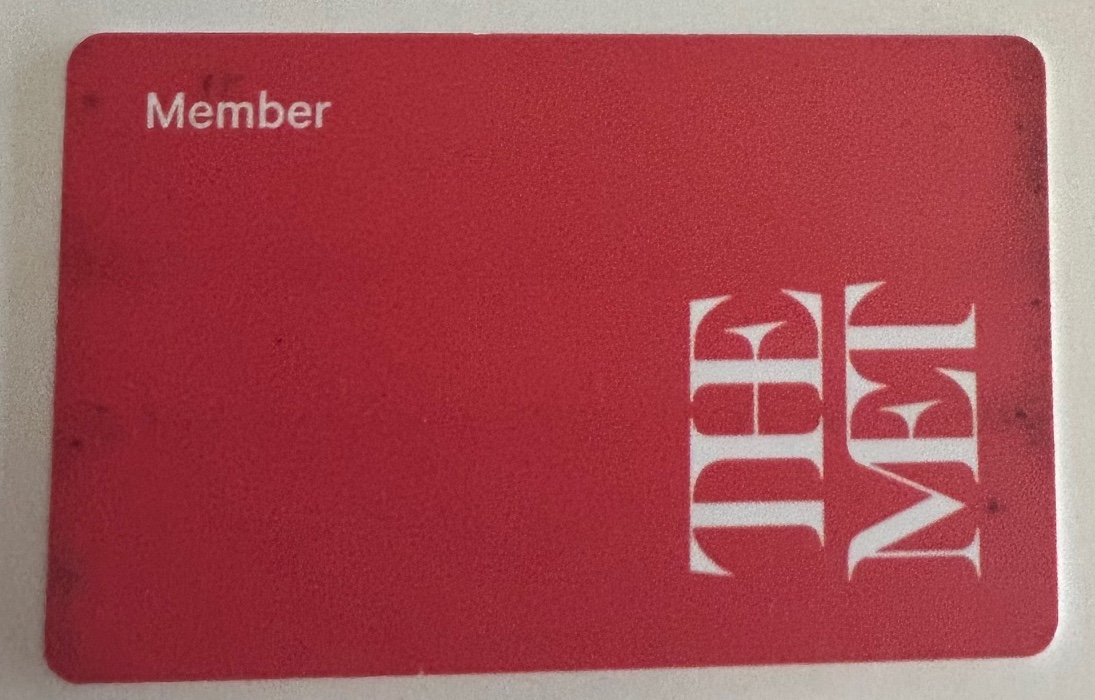
I’ve been a patron of the Metropolitan Museum of Art for almost 40 years. With my son long out of his Museum of Natural History phase, it’s the only museum in the city I’m sure to visit multiple times a year, sometimes on my own. Along with other visits, we make an annual event out of seeing the Christmas Tree and Neapolitan Baroque Creche plus whatever big fall show we’d missed up to then. And yet I’m convinced there are still some rooms, alcoves, special places in there I haven’t wandered into yet.
Let’s go back now to the fall of 2020, and my first time back at the Met since before it’s COVID-caused lockup. My membership had run out earlier that year but the museum extended everyone’s expiration date by the number of months it had been closed, so I could go straight in without stopping to renew.
Inside, the lights were dimmed, some not on at all (the museum has a lot of windowed inlets for natural light but it was cloudy that morning). A few wings were cordoned off and pathways to and through open exhibits were tightly defined. And the level of staffing was correspondingly reduced. Clearly, they weren’t expecting a lot of visitors at the outset. And indeed there were very few people inside, shadowy in the low lights, masked and wary, speaking softly if at all, socially distanced.
The central exhibit of the reopening was of the history of the Met itself and I wish they would install it permanently. Year by year, wing by wing, it mapped the institution’s evolution — the original and subsequent buildings, the addition of new departments and curators, important acquisitions like the Cleopatra’s Needle that sits behind the Met in Central Park, visible from several vantage points inside and on top of museum. There’s a story for you — from its creation in honor of Pharoah Thutmose III to it’s gifting to New York (London got one too), from Alexandria to Staten Island to the Great Lawn, that obelisk made quite a journey, and needed all the help it could get to do it.
As you can imagine, that exhibit had much to say about the role of the city’s social and business elite in making the museum a world-renowned institution. A favorite moment of mine came in the spring of 1880: the Met had grown so quickly that it was moving to its third home in just under a decade (the current location on Fifth Avenue). When the day came to transfer the museum’s holdings to the new building, a number of the city’s most prominent men showed up — not just to observe or supervise or order their staffs to help, but to join in the effort themselves. Along with providing vision, influence, money, and their own collected art, they hoisted and hauled, packed and unpacked.
It was a reminder that, in contrast to today’s titans of tech, some of those Guilded-Agers come off as quite the do-gooders. Arrogant, greedy, disdainful, self-aggrandizing, convinced of their own God-approved greatness, I’m sure. Maybe if they’d had the opportunity, they too would have felt entitled to do things like build an unregulated, pollution-spewing power plant near a predominantly minority community now facing an alarming surge of asthma cases. But they also had a genuine sense of civic duty, an obligation to contribute to the public good. They didn’t just stick their names on wings, buildings, libraries, halls, universities. They built them. To last. For others’ benefit even if also for their own.
Imagine that.
————————————————————————
As engaging as the exhibit was, the overall experience of that visit – the darkness, the mustiness, the masked people, the anxious quiet – was deeply unsettling. It really did feel like I was creeping around in a big building that had been closed for months. And you couldn’t forget that the pandemic was far from over and that being there at all was a risk. I was ready to leave in a little over a half-hour. That history-of-the-Met show had given me plenty to take home and overexplain to my family, friends, others with varying levels of interest. But I made myself stay longer, taking my time in galleries I normally glided through on my way somewhere else.
Such as 19th Century British Art.
Okay, admittedly some lovely stuff there. There are a few paintings but the focus is on the decorative arts. Lots of Victorian and Georgian-era craftsmanship on display – candlesticks, coins, serviceware, centerpieces. A whole tower of teapots. Things like that. I never spent much time in those rooms because I went to the Met to learn about other cultures and to see history-making art, not to admire rich peoples’ dishes. But on that dreary morning, the sheer candy-colored elegance of the objects proved to be worth a little admiration. I wouldn’t say it was uplifting, but it certainly was brightening.
And then…a real showstopper. Not something I’d seen at a distance and approached casually but something just suddenly there — him — looking right at me and clearly enjoying how much I was awed by his magnificent presence.
If you haven’t encountered him before, let me introduce you to…

Look at that face! If that couldn’t cut through a miasma of gloom, what could? I think I actually said, “Hello!” when I first met him, over my breath for all to hear.
“Wally Bird” is the nickname for this and similar pieces created in the late 1880s by R.W. (Robert Wallace, see?) Martin and Brothers in London. His official name in the Met catalog is “Jar in the Form of a Bird.” The entry explains that it was much the fashion in the late 1800s to give animals in paintings and craftwork a touch of the anthropomorphic. The Martins’ pottery studio produced a variety of vessels and other decorative pieces with humanlike faces, some whimsical, some a bit menacing. My Wally Bird is merely a Wally Bird, not the Wally Bird. There are other jars in the form of birds out there, including one at the Victoria and Albert Museum in London.
And see that crease around the neck? Yep, the head is a removable lid. He is, as advertised, a jar. But not just any kind of jar.
He’s a cookie jar!
The Met catalog states it clearly. This one’s for snickerdoodles.
The Wally Bird in the V & A is identified just as assuredly as a tobacco holder. I suppose there’s no reason why such jars couldn’t store either cookies or tobacco, as long as you don’t switch back and forth without giving them a good scrubbing. But according to the experts, the Met’s and the V & A’s Wallys were created for a specific, distinct purposes. And with that, I’ll take mine.
When I visit Wally, I look at him from all available angles. Each reveals a different Wally. In the photo I took on that first post-shutdown visit (above) we’re getting a sly, flirtatious side-eye. He seems to be channeling the attitude of that bird of legend, the Nurk, as described by Woody Allen in his 1974 essay, “Fabulous Tales and Mythical Beasts:”
The Nurk is a bird two inches long that has the power of speech but keeps referring to itself in the third person, such as, “He’s a great little bird, isn’t he?” 1
For the record, my Wally Bird would tower over your typical Nurk. He’s over a foot high.
The official photo of Wally in the Met catalog (below) was taken from the opposite side as mine, and has more of a “You were saying?” air to it. If the Wally in this photo spoke, he’d have the beautifully modulated intonations of, say, Patrick Stewart, and would refer to you as “my good man.” I look at the Wally in my photo above and hear the Cockney of Michael Caine saying, “‘Allo, Guv’na.”

Wally’s moved since I met him. He’s now in a glass cabinet at the entry to Room 516 (go to the wooden screen in the Medieval Art hall and make a right). It seems safe to say he’s a he. If you visit the Met you can take a look and draw your own conclusions about that, and about his attitude toward you. Keep in mind what he’s intended to be concealing. Depending on which side of him you’re on, he’s either your accuser or co-conspirator, either threatening to tell on you — or promising he won’t.
1The New Republic, November 30, 1974