
Note: This is the continuation of a story about an effort to gain approval for a massive real estate development project in Manhattan — one that would include the borough’s first fully-licensed casino. Part 1 looks at the developers of the project, the competing bids, and the process for getting the casino license approved. Part 2 focuses on one of the two public hearings held by a local community board convened to assess the Freedom Plaza license application. This part comes after reviewing both public meetings in their entirety.
I attended the second public meeting of the Community Advisory Committee reviewing the Freedom Plaza bid for a casino license in person. I stayed through Speaker Number 51 then relocated to the Red Hill office to watch the rest online. On my way out, I saw a man pick up Number 166. When I rejoined the meeting online, Number 70 was up.
At the time I left, more speakers had been in favor of the Freedom Plaza development than opposed to it. By the time I tuned back in, things had changed. The synchronized groups of union members and Mohegan/Soloviev employees who’d gotten their numbers together and who spoke one after another had had their say. There were still plenty of advocates for the project, but for the rest of that meeting, the majority of people at the mike spoke in opposition to the casino.
And quite a few of those citizens were residents of Tudor City.
_____________________
Note: if you’re familiar with Tudor City, you’re welcome to skip ahead. I’m including this for those who aren’t, to explain its role in the resistance to the Freedom Plaza casino.

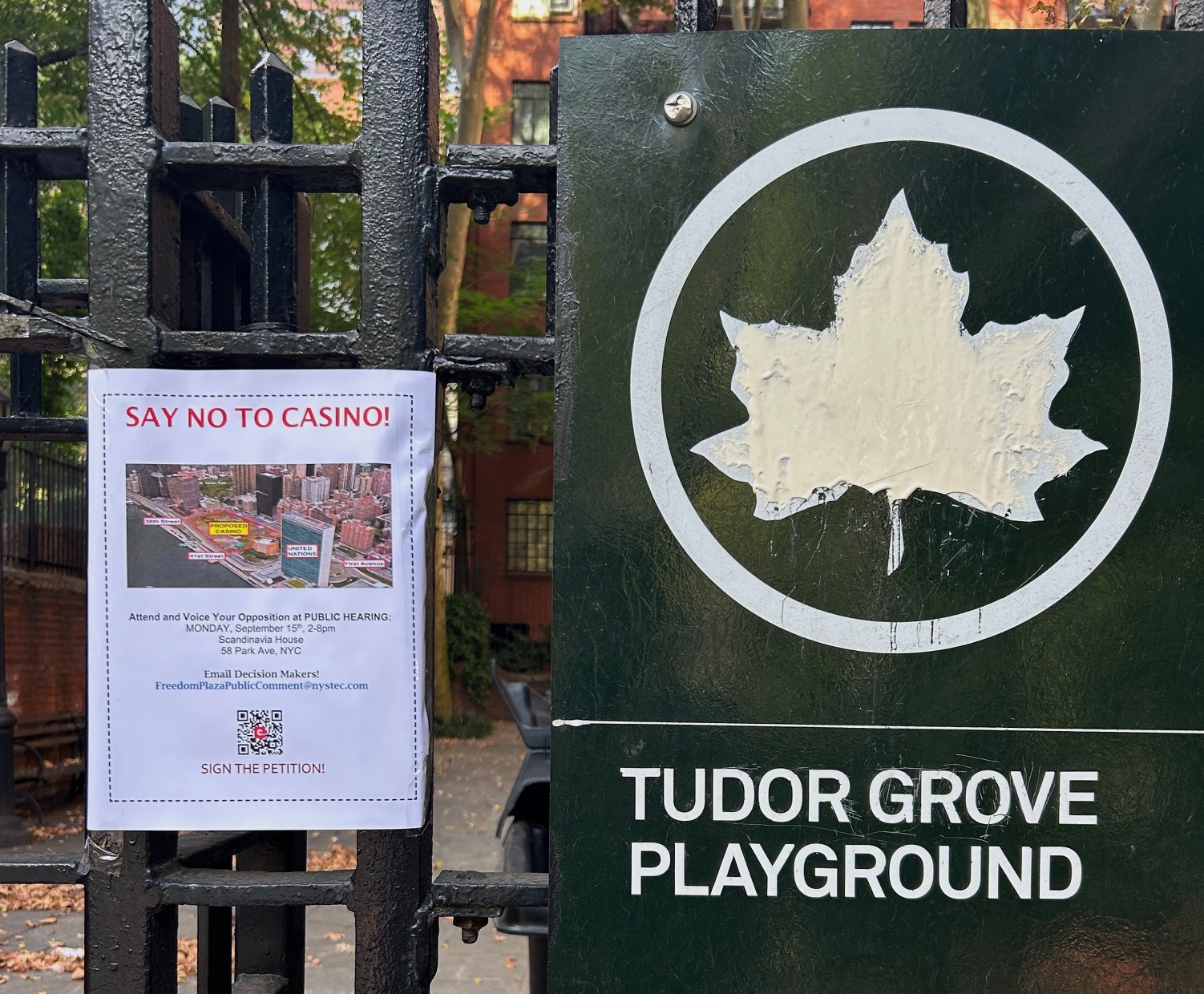
Tudor City is located between Second and First Avenues, from 40th to 43rd Street, across First Avenue and a couple of blocks up from Freedom Plaza. It consists of 12 apartment buildings and a hotel, and a couple of small well-shaded garden parks. It was built to provide middle-class homes near Grand Central Station and the growing Midtown office district, and when completed in the 1930s, it was one of the first large-scale planned urban communities in the entire world. The name reflects its distinctive architecture, which combines stone, brick, and terracotta facades with sloping roofs and ornate Tudor-style touches. It also reflects the developers’ intention of making the complex as self-contained as possible. Currently, there’s a bike store, a dog groomer, a cafe, a dry cleaner/tailor, a wine store, a tavern (in the hotel), and a steakhouse integrated into its footprint. At one point, there was an indoor golf course in one of the buildings, which was replaced by an outdoor miniature golf course in one of the small parks. Both are long gone.
It isn’t just the architecture that gives Tudor City its fantastical physical character. It’s the location as well. Tudor City sits on a granite bluff once known as Prospect Hill (a Tudor City community website refers to it as “Montmarte in Midtown.”) The property slopes upward from Second Avenue. Enter from 41st or 43rd and it feels like you’re walking up into a tree-protected estate. Tudor City Place, a two-block, north/south street within the grounds, provides a bridge over 42nd Street — about twenty feet above it. Stone staircases connect the sidewalks on either side of 42nd to the grounds above. At the end of 43rd, it’s a sheer drop to First Avenue, with a curving concrete stairway providing a way up and down.
Once within Tudor City, surrounded by elegant buildings and under the trees, it’s easy to see why residents would push back against any kind of perceived encroachment. It really is an enviable, insulated enclave, with stock-image views of the United Nations to the east and out 42nd Street past the Chrysler Building and Grand Central to the west. You can also see why some non-residents might think it projects an air of snobbish exclusivity.
What you can’t see very well from the grounds inside Tudor City is Freedom Plaza itself. You can only catch a corner of it from the 41st Street dead end. But with the property’s elevation, anyone with an apartment window facing east — even those with first-floor units — can keep track of whatever’s going on in there. Still, Tudor City doesn’t face Freedom Plaza (or the UN or the East River). It faces the other way toward Second Avenue. Windows with a view of the site are at the rear of their apartment buildings. Look west from Freedom Plaza and the tall, brick backsides of several Tudor City buildings come together like the wall of an imposing fortress, with you on the outside gazing up at it from across the moat.
_________________________
I watched the livestream of the meeting I’d attended to its conclusion, caught up on the part I missed, then later reviewed the video of the previous meeting. In all, 214 people picked up numbers to speak at that meeting and it didn’t end until all 214 were called. Some were not in the room when their numbers came up and missed their turns, but anyone who signed up had the opportunity to speak, and almost everyone did.
Looking back, if I’d experienced the meetings in the order in which they occurred, I would have noticed the ways the second meeting responded to the first:
— I would have understood why Soloviev CEO Michael Hershman spent so much of his opening presentation on the traffic issue. In the first meeting, with just a few minutes of remaining time, he’d opted to show a couple of video testimonials instead of going through the traffic section of his slides. That transportation engineer who spoke at the second meeting was also at the first one, but was not called upon.
— I would have known that the early influx of Freedom Plaza supporters I saw in person — those union members, community leaders, and Mohegan Sun employees who snagged clusters of consecutive speaking numbers — only happened in the second meeting. The Mohegan party bus only made one run.
— I would have noticed that the camera/microphone set-up for the speakers had been moved to the far left of the hall, then about halfway up the aisle. In the first meeting it was right in front of the committee, just off the stage in the middle.
— I would have recognized the people who spoke at the previous meeting as well. Like the representative of Black Pearl Investments who said if the license bid was approved, Black Pearl would provide $10 billion to finish the Second Avenue Subway (in the previous meeting, the offer was $9 billion). Or that former U.S. Ambassador at Large for Religious Freedom who was first up at the second meeting. She spoke at the previous meeting as well, but later in the session. (First up in the first meeting was Bo Dietl, security expert, former NYPD police officer, and sometimes actor who participated in the groundbreaking event for the Path to Liberty at Freedom Plaza.)
— But above all, I would have known why the committee’s administrator was so quick to scold the audience for the slightest murmur or groan or outbreak of applause. Her reactions were typically more disruptive than whatever provoked them. In hindsight, it’s clear she was trying to keep this meeting from becoming as confrontational as the first one. Not that the first meeting ever descended into outright chaos. By the standard of other public meetings I’d attended it was fairly normal. But it did escalate into raised-voice, finger-pointing rowdiness at times and the committee, through their enforcer, seemed determined to not let that happen again.
That led to a genuinely mystifying moment midway into the second meeting. A rabbi, redfaced and worked up, came to the mike and shouted, “All of the interruptions and heckling! This is the most undemocratic thing I’ve ever witnessed!” But up to then, under the administrator’s firm control and with the audience’s overall compliance, there hadn’t been any significant interruptions or shoutdowns that afternoon. A few minor blips, yes, but nothing that justified his accusation. Nothing. I wasn’t the only one to turn to a neighbor with an expression that meant, “Huh?”
___________________
In the first meeting, the residents of Tudor City and nearby neighborhoods were more direct in saying that most people in favor of the project wouldn’t have to deal with the consequences of having a casino across the street. The tone was often negative, grouchy, hectoring, as opposed to the upbeat vibe of many of the project’s supporters. Well, of course. That’s the difference between being for something and being against it. The people for Freedom Plaza were cheerleaders. The people against it were protesters.
One Tudor City resident turned away from the panel to address the room, and said, “Would you want this in your backyard?”
Later in that first meeting, another late-middle aged woman from Tudor City said, in a sweet but firm tone, “Our quality of life is going to go into the crapper.”
But neighborhood residents themselves were under more intense fire at the first meeting. It started early. Right after Bo Dietl, Speaker #2 said, “There are too many New Yorkers who are resistant to change.” It got a lot more pointed and antagonistic from there. “Tudor City” quickly became shorthand for anyone who lived near Freedom Plaza and was trying to block the casino.
By the time it was over, several speakers had explicitly excoriated Tudor City residents for being rich and self-righteous, for trying to stop a project a lot people would enjoy having, for wanting to keep their community to themselves. One young woman branded those residents “elitists” and said she was tired of hearing them lecture minorities and younger people about what was good for them.
A speaker at the first meeting said he volunteered at a soup kitchen financed by the Soloviev Foundation. Pointing at the crowd, he added, “That’s what Soloviev does. What do you do?” Another speaker played the NIMBY card and decided he needed to explain the acronym. Before he got through it, someone in the audience shouted, “It ain’t your backyard!”
But the most intense moment of pushback against “Tudor City” came late in that first meeting. Speaker 89 introduced herself as a former model. She was indeed tall, thin, white, and blonde. But she was shockingly aggressive in criticizing local residents who opposed the project. Facing the audience, she shouted into the mike, “Those who boo the loudest do the least!” She went on to say that white people only pretend to care about people they disenfranchise and accused the audience of only heckling people of color. (I can tell you that was absolutely not true. Plenty of white people — on both sides of the issue — had been heckled up to that point.)
______________________
Citizen after citizen came to the mike over those two meetings, motivated to come to Scandinavia House to voice their opinions. Some spoke eloquently without a text, some read something they or someone else wrote, some seemed to have rehearsed, some faltered so much you knew they weren’t going to beat the clock.
For all of demographic variety represented in the hall those two days, most of the proponents wanted Freedom Plaza to happen for the same reasons (jobs, housing, nightlife, economic boost), while those opposed to the casino made the same general arguments against it (crime, traffic, disrupting a residential neighborhood). The following speakers stood out because they were the only ones to raise certain specific issues or they offered something surprising:
— A Community Board from Stuyvesant Town came with the numbers. She was the only one to quote studies quantifying the negative effect of casinos on property values (National Association of Realtors), income equality (CNN, Institute for American Values), and rates of gambling addiction (National Council on Problem Gambling).
— On both days, ministers and rabbis overwhelmingly supported the project, citing the community benefits and the support Soloviev was already providing. But Speaker 27, a deacon from a Baptist church in Harlem, said, “We’ve gotten promises before. Look at Atlantic City. Go across the street from the boardwalk and there’s blight.” A couple of finance professionals also disputed Soloviev/Mohegan’s revenue projections, including one who studied the economics of casinos for a different project. But the deacon was the only spiritual leader to be skeptical that the casino would benefit the city. I didn’t hear any religious leader object to the casino on religious grounds. In fact, one rabbi said there was nothing in the scriptures that specifically labelled gambling a sin.
— One speaker from Tudor City railed against the Soloviev Group, belittling their community outreach efforts and saying, “They’ve already ruined the eastern end of Long Island!” He seemed to think he could rally the opposition by complaining about conditions in the Hamptons. Probably not the best way to counter the stigma of out-of-touch elitism.
— One speaker who lived near Freedom Plaza thought the brightness and continuous activity of the development would make the area safer. Several others made a similar point. But this speaker added that he was looking forward to watching his son play on the Freedom Plaza soccer field. There has never been a soccer field included in the plan for the site.
— One older female resident of Tudor City, who resembled so many of her neighbors against the project, not only spoke in favor of Freedom Plaza, but of the casino itself. “You people think casinos are all about the sleaze. But those were the old casinos. Look at James Bond! Monaco! Macau! Black tie every night!!”
— Another older Tudor City resident said he’d welcome the entertainment complex because he wouldn’t have to go too far for something fun to do. And he could see himself getting a post-retirement job there. “I may not be able to do much then, but I should be able to get across the street.”
— A young woman said she didn’t live near Freedom Plaza, but she was excited about its nightlife options. Then she turned to the crowd and ripped into Tudor City residents for not supporting people of her generation who were just trying to make it in the city. She said she was saving up to buy her own apartment and thought that an influx of affordable housing units would help with that.
— She was followed by another woman about the same age who was strongly opposed to Freedom Plaza as a whole (not just the casino). She was fearful of its negative environmental impact. Somehow, she was the only speaker to make that argument. The only other person to touch on the issue was from The Waterfront Alliance. He said the Freedom Plaza developers were working to get their WEDG Verification. He didn’t voice an opinion either way on the project and didn’t explain what WEDG was. (I looked it up. It’s a national rating system recognizing waterfront projects for resilient, sustainable, and accessible design.)
— One of the very last speakers, Number 210 of 214 at the second meeting, identified himself as a Columbia graduate and longtime Midtown resident who worked in real estate. He said it wasn’t right for people to speak so negatively about gambling. “Lots of good people in New York gamble, people who make a lot of money. If the casino was going into a poor neighborhood, it could create issues. But the people around where it’s going can afford to lose a few hundred dollars if they want to.” He was the only speaker I heard who thought gambling was getting a bad rap.
— Still, perhaps the most surprising speaker I saw was Number 30 in the second meeting. She came to the mike, introduced herself as a native New Yorker and longtime eastsider, gave her previous and current zip codes, said she was in favor of the project — and turned and walked away.
____________________
One last notable difference between the two public meetings: In order to accommodate everyone who wished to speak, the second meeting went around 20 minutes over its six-hour time allotment. The committee stayed till everyone had spoken, without complaint or any sign of frustration. In contrast, the first meeting ran out of speakers about 20 minutes short of its scheduled four-and-a-half hour length. After soliciting for more comments a couple of times, the chairperson accepted the situation and adjourned early.
The last speaker at that meeting (Number 139) was against the whole project, not just the casino. Among her concerns was something no one else had or would later express. Sunlight. Worried about the inevitable shadows Freedom Plaza would cast, she said, “Children need sunlight. That’s just a fact.”
_______________________
The Freedom Plaza Community Advisory Committee met a week after the public meetings concluded to hold a final vote on the casino license bid. Part 4 covers that meeting as well as the fate of the other proposals vying for a downstate casino license.