
Note: This is the conclusion of a story about an effort to gain approval for a massive real estate development project in Manhattan — one that would include the borough’s first fully-licensed casino.. In case you came across this segment first, here Part 1, Part 2, and Part 3.
The Final Votes
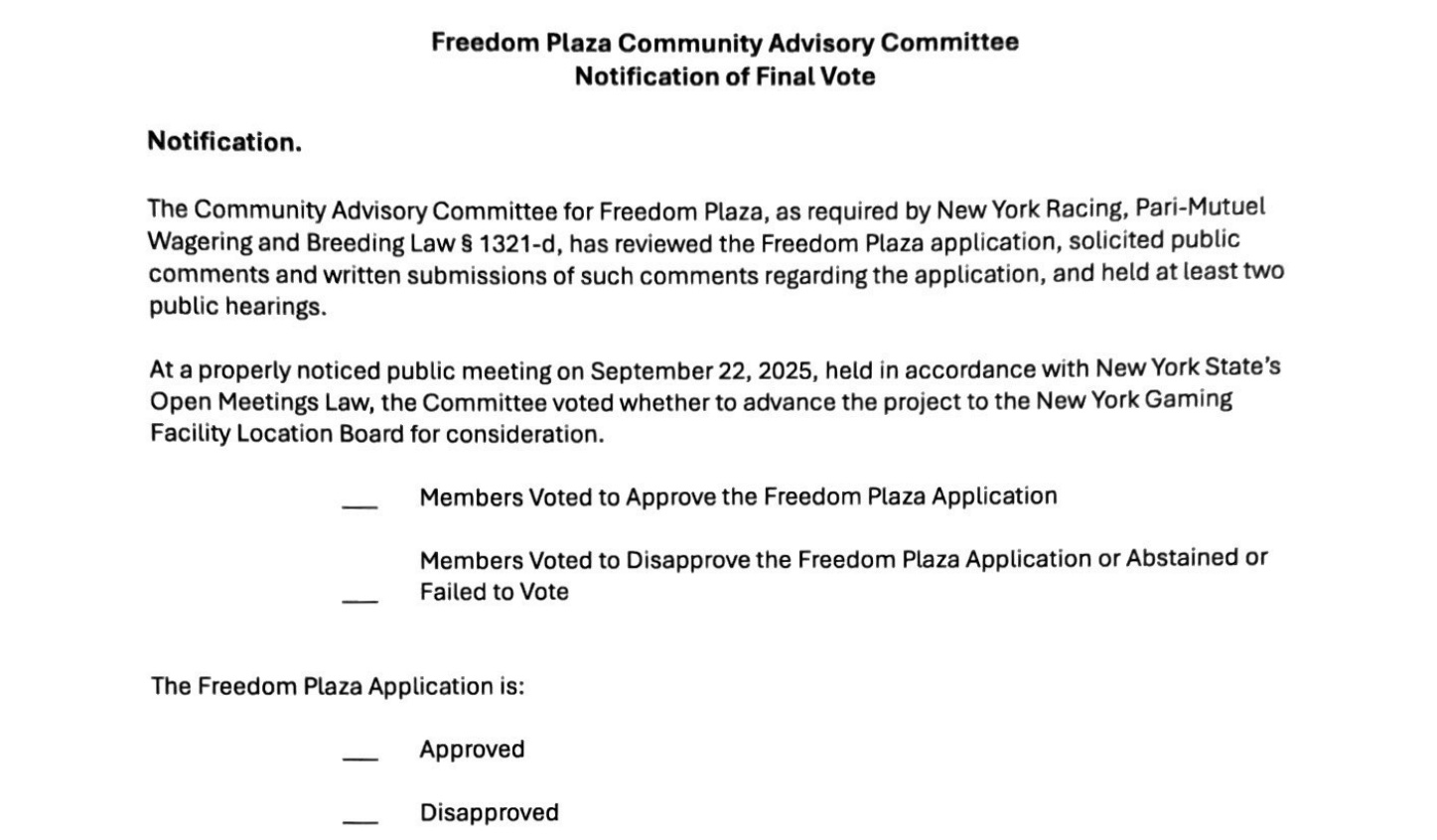
The Community Advisory Committee for Freedom Plaza held their final vote on the project’s casino license application on Monday, September 22. The meeting took place in the offices of Manhattan Community Board 6 on East 43rd Street, just a few minutes walk from the proposed location. The application needed at least four votes in favor to be advanced to the next approval round.
By that time, the fate of the other two Manhattan-based casino proposals had been determined. The previous Wednesday, at nearly the same moment of the morning, both the Times Square and Hudson Yards applications were rejected by a vote of 4-2 against, the two votes in favor coming from members appointed by the New York City mayor and the New York governor.
Marc Holliday, chief executive of the developer whose building would have hosted the casino, did not take the rejection gracefully. According to The New York Times, Holliday confronted committee members outside the Times Square office where the vote was held, calling them “despicable.” The Times also reported that Holliday was in line for a $10 million bonus if Times Square bid was approved.
The developers behind the Hudson Yards casino bid expressed their disappointment in a more measured way. Their main contention was that they should have been given more time to respond to questions that arose in their public meetings. But the committee stuck to its schedule and held the vote.
___________________________
Back to the Beginning
The official work of the Freedom Plaza Community Advisory Committee began with an organizational meeting on July 17th, about two months before their final vote. It was not open for the public to attend in person but was livestreamed and posted on the New York State Gaming Commission’s website. I watched the recording of that first meeting the day before the committee held their last one.
The meeting was in a room in the Community Board 6 offices. Committee members were on one side of an oval table and representatives from Soloviev and Mohegan were on the other. Additional members of the Freedom Plaza entourage sat behind them, only occasionally on camera.
The setting appeared to be a bit improvised. A gray padded divider behind the committee members’ side of the table sealed off some square footage of the room. A box for an office printer was visible high against the back wall behind the divider, nearly touching the ceiling, askew from resting on something stacked crooked. The tops of several other boxes peeked over the divider as well, also slanted. It gave the impression that this was a “just put it in there for now” kind of room.
That administrator who later maintained order at the public meetings was there to handle parliamentary duties and keep things on schedule. But it was all very cordial — she never had to get tough with anyone.
An hour and a half of the meeting’s scheduled two hours was taken up with a detailed walkthrough of the Soloviev/Mohegan proposal — slides, renderings, videos, testimonials. Soloviev CEO Michael Hershman characterized the project as an updated version of the Solow Group’s original proposal for the site, which was approved in 2009. Hershman highlighted the public benefits of the plan’s improvements (expanded park, the museum, affordable housing, increased security, more ways of alleviating traffic congestion). Committee members were welcoming and engaged but none of them gave any indication of how they felt about the project in general or the casino in particular.
After the presentation, much of the remaining time was taken up with one question from the mayor’s appointee: why were there so many fewer apartments compared to the original plan? Hershman had actually addressed this in his presentation. It was the result of going from three apartment towers to two. He again explained that this was done to clear space for a bigger park and more parking within Freedom Plaza. He added that while there were fewer apartments overall, the plan now included a significant number of affordable units.
But the committee member couldn’t get past the reduction in total units. She wasn’t grilling Hershman or acting like she’d uncovered something fishy. She wasn’t pushing for those units to be added back. She just kept asking about it. And it didn’t register that Hershman already answered her question. Nor did it seem to matter that while the overall number of apartments was coming down from 1300, the number of affordable units was going up — significantly — from zero.
Note: The standard definition of “affordable” in New York City is that rent should be no more than ⅓ of a person’s or family’s monthly income. According to their presentation deck, Freedom Plaza’s rent calculations would follow the state’s Mandatory Inclusionary Housing (MIH) guidelines, and would be based on the average salaries of teachers, nurses, municipal employees, retail workers, and construction tradespeople.
In addition to the meeting video, the Gaming Commission site posted additional correspondence from the Freedom Plaza Team, providing answers to questions raised during the review process. Both letters were signed “The Freedom Plaza Team.” That’s where I got the name.
A letter dated August 4 explained the revised total of apartment units yet again, and added that Soloviev wasn’t required to include any affordable housing in the plan but was doing so anyway.
A letter dated August 26 (two days before the first public meeting) addressed the new plan’s increased number of parking spaces. The letter explained that the hotel and casino were not in the original plan and would generate a need for more parking. The letter also stated that providing parking within Freedom Plaza was not required either but would help mitigate traffic congestion around the site.
The gaming commission also provided a downloadable pdf version of the Freedom Plaza Team’s presentation deck. Going slide to slide confirmed my initial impression from the project’s website, email, and social media campaigns. Just as with those communications, the slide deck did its best to downplay the presence of a casino in the plans for the site. While the word “gaming” appears on seven of the deck’s 41 slides, the word “casino” does not appear at all.
___________________________
Back to the End
The final Freedom Plaza committee meeting was held in the same room as the organizational meeting (there was that printer box again, looming up toward the ceiling behind the divider). The camera focused primarily on the committee but occasionally turned to show the audience, a few rows’ worth. If there were any proponents of the license bid in attendance, they were vastly outnumbered. Quite a few people brought homemade signs expressing their opposition to the casino. No representatives from Soloviev or Mohegan were present.
The meeting was called to order a couple of minutes after 10 am, and turned out to be much shorter than the multi-hour public sessions. The whole thing took about nine minutes.
It began with the news that Soloviev wanted to amend their proposal and that the committee needed to vote on whether to allow that first. The change was to classify all apartments within Freedom Plaza as affordable, instead of 50% as previously offered. The committee quickly rejected the request by a vote of 4-2 against, the two votes in favor cast by members appointed by the New York City mayor and the New York governor. I assumed the “no” votes were on procedural/timing grounds, but no committee member offered an explanation for his or her vote.
Next came the final vote on advancing the casino license application to the state’s Gaming Facility Location Board, which would then decide which bids to forward to the Gaming Commission. After thanking the committee for their work and the public for its involvement, the chairperson polled the other members, allowing each of them time to speak before voting. A couple of the members did so, also thanking the committee for its work and the public for its involvement. The chairperson voted last.
It was 4-2 against, the two votes in favor cast by members appointed by the New York City mayor and the New York governor.
The meeting’s adjournment brought a vigorous round of cheers from the audience. One opponent of the casino was so relieved by the outcome that she broke down in tears while being interviewed by a reporter from a local television station.
_______________
The Remaining Votes
On September 25, three days after the last Manhattan-based casino application was rejected, both the Yonkers Raceway and Aqueduct proposals received unanimous support from their committees.
On September 29, the casino license bid for a proposed development at Coney Island was rejected by a vote of 4-2, the two votes in favor cast by members appointed by the New York City mayor and the New York governor.
That same day, the Bally’s casino license application for the Ferry Point project in the Bronx was advanced by a 5-1 vote in favor. The lone vote against it came from the member appointed by the location’s City Council representative.
The next day, the Hard Rock/Metropolitan Park license application for a development adjacent to CitiField in Queens was approved 6-0. That would suggest limited local opposition but according to The New York Times, one of the public meetings for the bid became so confrontational that the committee had to shut it down early.
That made four advanced applications for three licenses. Since both the Yonkers Raceway and Aqueduct proposals involve expanding existing gaming operations and had strong local support, those would seem to be well-positioned for final approval. For the remaining license, it looked to be a showdown between the Hard Rock project spearheaded by New York Mets owner Steven Cohen, and the Bally’s Ferry Point project at the South Bronx golf course once owned by the Trump Organization. Bally’s purchased the lease for the New York City-owned property from the Trump Organization in 2023, paying $60 million. If Ferry Point gets a casino license, Bally’s will owe the Trump Organization an additional $115 million.
After their bid for a Freedom Plaza casino license failed, the Soloviev Group issued a statement: “Manhattan is the undisputed capital of the world and it deserved a fully integrated resort that would have attracted visitors while serving the needs of its community.” Articles in Crain’s New York Business and The Real Deal assume that Soloviev will come back with a new proposal for the site.
___________________________
Plot Twist!
On October 14, MGM announced they were no longer pursuing a license to operate a casino adjacent to Yonkers Raceway. It was a stunning development considering the years and millions MGM had spent on the project and that their bid looked to be a shoo-in.
The MGM press release stated that “since submitting our application in June, the competitive and economic assumptions underpinning our application have shifted, altering our return expectations on the proposed $2.3 billion investment.” Among the assumptions that shifted: MGM was looking for a 30-year license, but the state informed them that they would only be eligible for a 15-year license.
Yonkers Mayor Mike Spano immediately accused Bally’s and the Trump Organization of influencing the withdrawal. Spano pointed out that with MGM’s decision, there are three applications remaining for three available licenses — and that the Trump Organization gets that $115 million if the Bally’s gets a casino license for Ferry Point. The mayor asked New York Governor Kathy Hochul to open an investigation but she has declined to do so.
Reminder: Just because there are three remaining bids for three available licenses, that doesn’t mean each applicant will get one. The final decision rests with the New York State Gaming Commission, and they can award as many of the licenses as they want, or as few, or as unlikely as it seems, none.
___________________________
In the end, if not predetermined, the final vote on the Freedom Plaza bid was predictable. The “yes” votes came from representatives of the mayor and the governor — officials representing broad constituencies and larger economies. It made sense that they would be attracted to the plan’s promises of jobs, revenue, and affordable housing, even if it meant getting crossways with the residents of a section of Manhattan.
But for the members who voted “no” and their appointing officials, that section of Manhattan isn’t just a small group of precincts. It’s home. And there, within those areas in the immediate vicinity of Freedom Plaza, an overwhelming majority of the residents made it clear that they opposed the casino. It’s likely those officials and their appointees had the same objections as most of their neighbors, and didn’t needed much persuading at all.
And as for those elected officials, they would be mindful that they were put in office by voters from those precincts, who would have opportunities to vote again.
The same vote breakdown ended the other Manhattan-based bids. It might seem that the Times Square and Hudson Yards proposals had a better chance than Freedom Plaza because their locations were at some remove from the residential parts of their neighborhoods. I thought that too. But in both instances, the main reason given for the bid’s failure was resistance from people who lived nearby. In the case of the Times Square bid, that local opposition also included a well-organized campaign by the Broadway community to keep a casino out of the Theatre District. After all, it’s their neighborhood too.
And that is the hurdle any bid for a casino in the borough will have to clear: with the exception of a few pockets of a few blocks, all of Manhattan is residential. All of it is neighborhoods. On this island, any place anyone wants to put a casino is bound to be in somebody’s backyard.
___________________________
The Path to Liberty Revisited
A week and a half after the Community Advisory Committee declined to advance the Soloviev/Mohegan application for a casino license, I paid another visit to Freedom Plaza. The 20-foot tall image displays remained in place along the winding pathway, but the overgrowth of grasses and weeds seemed to have accelerated. Some of those plants were well on their way to becoming trees.
There was a different security guard at the corner of 41st and First Avenue. It was earlier in the day than my previous visit, so this guard had more shade than his predecessor, but he too had an umbrella at hand. I walked down 41st Street to the proposed entrance to Freedom Plaza and spotted, surprisingly, a couple of workers inside the fence, one sitting in a chair in a shady spot and the other emerging from one of several anchored trailers in the site. Neither looked like they were revving up to start working on either the installations or the weeds.
I’ve been by a few times since and I have seen some progress within the site — progress in dismantling it. I didn’t see anyone working at any particular moment, but the images on those installations along the winding pathway have been removed, leaving only the skeletal structures that held them.
Another time passing by, I saw a man and boy standing at one of the gaps in the blue vinyl wrapping along the First Avenue side of the site. The man was aiming a camera over Freedom Plaza to photograph a stunning orange-to-blue sunrise behind the apartment towers on the Queens side of the East River. He held the camera as high as he could while still being able to control the shot, trying to keep any trace of The Path to Liberty out of the frame.