
The Public Meeting in Person
Note: This is the continuation of a story about an effort to gain approval for a massive real estate development project in Manhattan — one that would include the borough’s first fully-licensed casino. Part 1 looks at the developers of the project, the competing bids, and the process for getting the casino license approved. This part focuses on one of the public hearings held by a local community board convened to assess the Freedom Plaza license application.
Scandinavia House
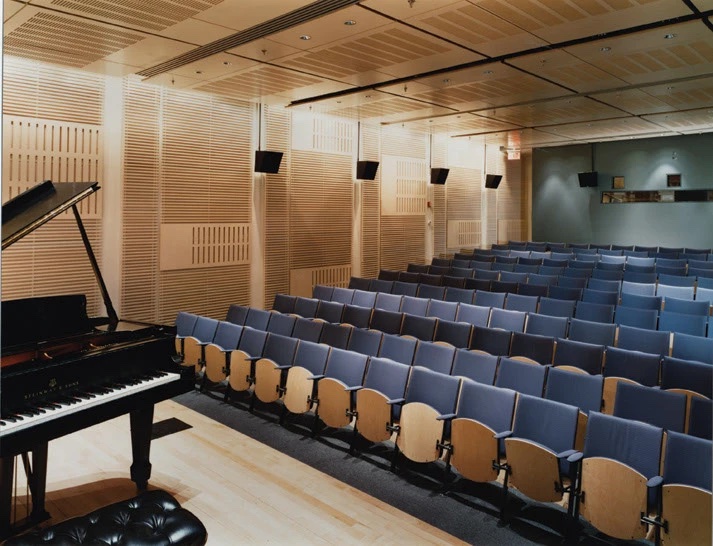
Located on Park Avenue between 37th and 38th Streets, Scandinavia House is a center for Nordic culture that hosts programs, concerts, and art exhibits. The entire fourth floor is a children’s play area funded by the Heimbold Foundation (Charles Heimbold was a former U.S. Ambassador to Sweden). There’s a floor named after Nobel Literature laureate Haldor Laxness (Iceland) and one called Volvo Hall (Sweden again). You can get something to eat at the cafe named for Björk (Iceland again). Level A, one floor below street level, has an auditorium named for musician/comedian Victor Borge (Denmark). That was the site of both public meetings of Community Advisory Committee reviewing the Freedom Plaza casino license application. I attended one of those meetings in person (okay, half of it, then watched the remainder of it at the Red Hill office).
When I arrived, around 15 minutes before the meeting was scheduled to begin, the line to get in was about a half-block long, almost reaching the corner of 37th Street. Two security guards and a young woman with a clipboard were at the door. At first I thought the line was stacked up because they were looking at bags or had a metal detector, but it turned out they were just trying to keep Victor Borge from being overcrowded — and were making sure visitors there for reasons other than our meeting weren’t being held up. After a few minutes of no progress, the line started to move, and did so efficiently. I was inside, downstairs, and in the theater before the event started. But by that time, all of the seats were taken, so I stood in the back.
While waiting outside, I picked up on some conversations around me. One wasn’t really a conversation because only one person was doing the talking. He was a campaign operative for a city council candidate for the district that included both Freedom Plaza and my home. Stocky and bearded, he was there to affirm that his candidate was firmly against the casino. But he was projecting his voice so loudly that while nominally speaking to the woman in front him, he was more or less addressing all of us waiting to get in, and anyone else that happened by. He was one of those campaigners who continue to itemize his candidate’s positions and accomplishments, as well as the opponent’s flaws, long after being told, “That’s who I’m voting for anyway.”
Just ahead of me in line, there were two couples who appeared to be longtime friends. It came out that they lived in Tudor City, the apartment community across First Avenue from the site of the proposed casino, and not surprisingly they were there to speak against it. What was surprising was that they were harassing a young woman in line just ahead of them. “Harassing” may be too strong. Needling, pestering, more like that.
“Are you being paid to be here?” one of the husbands asked, not aggressively but more than once. She didn’t turn to answer. I recognized her when she spoke in favor of Freedom Plaza about an hour later. Just ahead of her in the line outside were several fairly large men wearing red t-shirts that identified them as union members. Later in the meeting, they spoke just ahead of the young woman — one after another — also in favor of Freedom Plaza. The couples in front of me didn’t ask them if their attendance was being compensated.
________________________
The Presentation
Many of the photos I found of Victor Borge Hall showed a grand piano on the stage. The piano was donated by the “Great Dane” himself. Borge was in attendance at its unveiling in 2000 when Scandinavia House opened. He died a couple of months later at age 91.
The piano had been moved offstage for the Community Advisory Committee meeting. The committee sat at a table on left side of the stage, with representatives from the Soloviev Group and the Mohegan tribe at a table on the right. Both tables were angled so that the people on stage could easily speak across to each other or address the audience. The sign language translator stood far left behind the committee chairperson.
After some introductions and parliamentary business (establish quorum, approve minutes), there was a presentation by Michael Hershman, CEO of Soloviev, and Nelson Parker, Chief Strategy Officer for Mohegan. The first takeaway from that presentation was that even high-level executives representing real estate and gambling interests worth billions can have trouble with the slides. But the issues were quickly resolved, and the audience seemed to find it more charming than annoying.
Once things got rolling, the Soloviev CEO announced that their plan had been amended to include an even greater percentage of affordable housing*. He then focused on the Group’s commitment to community organizations and neighborhoods around Freedom Plaza through the Soloviev Foundation. The most dramatic example of this was a fund to be monitored and disbursed under the direction of the New York chapter of the National Urban League. After an initial $5 million direct contribution from Soloviev, the fund would get 2% of the casino profits annually. Hershman estimated that the total amount could reach $250 million in the next 20 years.
Note: the standard definition of “affordable” in New York City is that rent should be no more than ⅓ of a person’s or family’s monthly income. In his presentations to the committee and at the public meetings, Hershman explained that Freedom Plaza’s affordable housing rent calculations would follow the state’s Mandatory Inclusionary Housing (MIH) guidelines, and would be based on the average salaries of teachers, nurses, municipal employees, retail workers, and construction tradespeople.
At this point, Hershman played a video from Mark Morial, former mayor of New Orleans and current president of the National Urban League. Morial spoke about the economic success of casinos in New Orleans and how Freedom Plaza could bring that same surge in jobs and tax receipts to New York.
I did some research later and found one independent study from the University of New Orleans showing that revenue and employment gains from the New Orleans casinos fell well short of initial projections. The study also showed that gambling didn’t so much attract tourist dollars as reroute them from other entertainment options, that the casinos got most of their money from local residents anyway, and that all of the fears of legalized gambling’s social impact were being realized (increased gambling addiction, crime, family breakups, etc).
But that study was published over three decades ago and I couldn’t find any others on the same topic that were more recent, except a 2018 report on the increase of gambling addiction in Louisiana but that was for the whole state, not just New Orleans. The rest of the studies available focused exclusively on the revenue generated by the casinos, with no mention of whether that revenue exceeded or fell short of projections. Those studies were released either by the state of Louisiana or by groups created by or affiliated with the gaming industry.
Hersham then spoke to concerns about traffic. He stressed that the casino entrance would be from an access road on the northeast corner of the development, not from First Avenue; that most customers would arrive on foot or from within the site; and that Soloviev would run shuttles from Grand Central, Penn Station, and the Port Authority Bus Terminal. Hershman then introduced a young woman on the panel with him as a transportation engineer working with the project’s architects and engineers. She confirmed that Soloviev had studied the traffic problem extensively, had plans to address it, and would continue to monitor traffic even after Freedom Plaza was open.
The CEO concluded this part of his presentation by saying excessive traffic congestion around Freedom Plaza wasn’t good for them either.
Next, Mohegan’s Nelson Parker played a couple of video endorsements for the tribe and their Connecticut casino. The first featured the police chief in nearby Groton, Connecticut. (In his pronunciation, Groton rhymed with “rotten.” Some people in the audience laughed like they thought he’d said it wrong.) The Chief said Mohegan management had been especially helpful with law enforcement especially in the area of criminal investigations. Next came a message from the President of the New England chapter of Mothers Against Drunk Driving (MADD). He (yes, he) said the Mohegans were good partners with his organization as well. That sounded to me like the tribe was acknowledging that casinos were a source of criminal activity and drunk driving, but that they had considerable experience at mitigating those things.
____________________
The Public Speaks
After the presentation, the Soloviev/Mohegan table was removed and the committee table turned to face the audience. A couple of the Soloviev/Mohegan panelists transportation engineer. A microphone and camera for live streaming the public comments were placed in the far right aisle several rows up from the stage.
When the room was ready for speakers, the chairperson reminded audience members that everyone would get two minutes (a large countdown timer was projected on the curtain in the back of the stage). The chair also admonished the crowd to be respectful (no clapping, no booing, no heckling, cellphones muted) and asked speakers to leave when finished so more people could come into the room. At around 2:50 pm, the committee’s administrator* asked Numbers 1-5 to line up at the mike, reminding the audience that numbers for speaking were being given out at a table outside the hall. When I’d passed that table on my way in an hour earlier, someone had just been given Number 110.
That’s when I started to wonder if the scheduled six hours for this meeting were going to be enough.
*”Administrator” is my term. She ran the meeting, took notes, and kept things moving, but she was never introduced.
Speaker Number 1 was the Reverend Suzan Johnson Cook, former Ambassador at Large for International Religious Freedom in the Obama Administration and the first female Chaplain for the NYPD. She began by quoting scripture. She said, “Do justice and walk humbly.” That’s pretty close to Micah 6:8, King James version. It served as an epigram for endorsement of Freedom Plaza, where she made particular note of Soloviev’s commitment to affordable housing, women-owned businesses, and minority hiring. She said nothing about the casino.
Reverend Cook was the first of many speakers with religious affiliations to speak in favor of Freedom Plaza. Nearly all of the others were from local organizations based in Hispanic, African American, or Jewish congregations and communities. The Soloviev Group had not only engaged with an impressive range of organizations (faith-based and secular) but had made sure representatives of those groups were at the meetings to speak.
Dozens of them.
I wrote in Part 1 that I didn’t understand why spiritual leaders would be in favor of a casino. It turned out that the answer was pretty simple. If a contribution from gambling revenue helps you meet your fundraising goals and expand your programs, why not take the ill-gotten gains and do good with it? Actually, I didn’t get the sense that most of the representatives of faith-based community groups in favor of the project considered the gains all that ill-gotten. No one suggested only accepting funding from the other profit centers in the project and staying away from the gambling money. In fact, despite addressing a committee whose sole purpose was to rule on the casino license application, speakers from the spiritual community rarely expressed an opinion about the casino either way.
Unions were also well represented at the meeting. That young woman and the small cluster of men in the red shirts ahead of me in the line to get in were just a fraction of the number of officers and rank-and-file members in attendance (men and women). Their moments at the mike were remarkably similar. Each gave his or her name and union affiliation, and each expressed support of Freedom Plaza because of promise of thousands of good paying union jobs. None acted like they were enjoying the spotlight or were intimidated by it.
Several people who worked at Soloviev took the opportunity to speak highly of their employer. Most of them read their statements off of their phones and quite a few spoke with either a Slavic or Hispanic accent.
But by far, the largest contingent of people speaking in favor of Freedom Plaza in the early part of that meeting weren’t from local community groups or unions or Soloviev. For that matter, they weren’t even residents of New York City. They were employees of the Mohegan Sun Casino in Connecticut.
Of the 50 speakers I heard in person, nearly half worked at Mohegan Sun. In all, over 40 Mohegan employees spoke. Each had a personal story of how the casino management treated him or her like family, how they’d provided a career opportunities when not many other options were available. One young man offered a heartfelt confession of how working for such a caring company helped him redirect a life nearly derailed by bad choices. Another woman said she’d had health issues that ultimately led to her being in a medically induced coma, “and Mohegan Sun was right there by me the whole time.”
Even more so than the union speakers, the Mohegan Sun employees came in waves, six/seven/eight in a row. They must have arrived together and hit the table for speaking numbers in groups. One of the last of the Mohegans more or less gave it away. When gushing about how close-knit casino employees were, she said, “We love each other so much. We all came down here on the party bus!”
____________________
It was time for me to leave. Outside the auditorium, a couple of hours after first going in, there was still a line at the table to get a number to speak — someone had just picked up Number 166. (The last person I heard speak was Number 51). Upstairs and out on the sidewalk, people were still queueing to get in, although not as many as when I’d arrived.
Up to that point, the overwhelming majority of speakers had been in favor of the casino. But when I joined the livestream of the ongoing meeting a half-hour later, things had changed.
A Note Again: I concluded Part 1 by wondering if there would be drinks and snacks for meeting attendees. There wasn’t anything set out for us when I went into the auditorium but there was a pretty nice spread in place when I came to head home — coolers with water and soft drinks; a multilevel tray tower of sandwich wraps,; baskets with bags of chips; a station for cookies, pastries, and other handheld desserts. One fellow attendee was making her selections at the same time as me, an African American woman who looked to be about my age and who had spoken earlier on behalf of a community group in favor of Freedom Plaza. We talked a bit while decided what we wanted — not about the casino but about the abundance of food before us.
She took a lot more than I did.