
When I talk to people who were here on 9/11 and through its aftermath, we all agree on at least one thing: if you didn’t smell it, didn’t have to fight inhaling it, you can’t fully comprehend what it was like. That smell – burnt, ashy, wet, rotten — it was like inhaling a death you feared would settle into your lungs and stay there through every breath you would ever take the rest of your life.
My story of that day is not a harrowing tale, nothing close to what so many others endured. My wife and son and I were never in any immediate danger. We did nothing heroic, nothing reckless, nothing but just get home. Our greatest contribution was to take care of ourselves and not get in the way.
But it’s the anniversary, and I’m alone in the apartment, which doesn’t happen as often as I thought it would after I was laid off. So I’m writing down what happened.
_________________________
I was working in an office building on the corner of Madison Square Park, one of the last tall Midtown buildings before getting to the more modest heights of the Flatiron, Soho, and Tribeca (or one of the first if you’re coming from the other directions). Our company had the full floors of 35 and 37 where I was, high enough that from our south wall we had unobstructed views of the Twin Towers around three miles away. My office windows faced north, so I had no indication that anything was happening until a coworker, whose office was around the corner facing east, appeared at my door.
She was a bit of a busybody, often ducking in to complain about something or another, some idiocy she’d had to endure on her commute or some policy or project she thought was nonsensical. She shared these judgments with me not because we were office buddies but because most of the time I was the only other one there in our corner.
That morning, she said, “You’re not going to believe this. Some idiot just flew his plane into the World Trade Center.”
_________________________
Our main conference room was on the northwest corner of the floor, facing away from the Towers. The windows offered why-I-moved-to-New York views west across Manhattan and the Hudson to New Jersey, and uptown to Times Square and Rockefeller Center. I was told once that our parent company’s Board of Directors, almost all from Germany, scheduled meetings in New York just because they loved that conference room. We always had to clean up our offices in advance of their arrival.
Someone got the television in the conference room working. Somehow, without cable or a high powered antenna, they were able to get the Long Island Public Television channel, which was broadcasting news coverage from the BBC.
Not far into the morning, I began going around the floor in a circuit, first to an office on the south wall to watch the situation at the Towers get worse, then to the conference room to get the latest from the BBC, then back to my own office to see what CNN and other internet sources had to show and say and to try to make calls to my wife at her office in Soho, and to my family in Oklahoma. No matter who I was trying to reach, there was no signal, no call connected. My frustrations at not getting through to anyone reminded me of trying to call my brother after the Oklahoma City bombing. When he finally called me, his message didn’t seem to be in response to any concerns I might have had.
He said, “F–k this sh-t, I’m going for barbecue.”
I made several laps around the office, south-facing window to conference room to my own desk. At one point at my desk — I swear this is true — I saw a report on CNN that a car bomb had gone off in front of the Supreme Court building in DC. I know that morning was filled with fear-born misinformation and speculation, and we all know that no such explosion actually happened, but absolutely no one I’ve ever spoken to about it has ever confirmed that they too saw such a report. And I can’t find any trace of it online either.
I was in my office when the report came in that the South Tower had collapsed. I ran to the office where a group of colleagues were watching the event but they didn’t realize what had happened, because the column of smoke and ash left behind retained the Tower’s shape. Even when I told them what had happened, some remained skeptical, convinced that the perfectly formed residue was still the Tower itself, not its evil mocking ghostly shell.
After the second Tower collapsed, the company president sent us all home. I still hadn’t been able to contact my wife, whose office was a couple of miles closer to the Trade Center site but, to me, not in the immediate circle of destruction. So I went straight to my son’s daycare, which was conveniently located on the way between the office and home. He was cared for by a middle aged gentleman named Tony, a certified child care worker who took two or three children at a time in his apartment, ages six months to three years. Charles was a year and a month old.
The mothers of the other two children were already at Tony’s, and the three of us, children in our laps sat with Tony in the dim light of the apartment, watching the news on a small TV that at that time of the morning was usually tuned to Mr. Rogers or Teletubbies. Nobody wanted to leave that cozy place where we’d all met a few months earlier.
About a half hour after I got to Tony’s, my wife showed up, not sure if I’d already taken Charles home. Her Aunt Sue was with her. At the time, Sue worked for the Army Corps of Engineers, just a few blocks from the Trade Center. As soon as the first plane made impact, she left her building and walked up to my wife’s office to get her, then the two of them walked to Tony’s. Sue lived in New Jersey. She stayed with us until early evening, when trains began running again.
We left Tony’s and walked the few blocks to our apartment complex. We live on the top floor of a 22-story building. Our apartment faces south and we could see the plume of smoke and ash from the Trade Center Site from our window and were beginning to catch the first wisps of that awful smell.
At some point later that morning, everyone realized they were hungry. I proposed that we get an order from Sarge’s, the venerable, old-school delicatessen a few blocks away. It took awhile for someone to answer my call, and when she did, she let me know that takeout orders were running up to two hours behind. They weren’t crowded and would be eating much more quickly if we went there. So we did.
Sarge’s was certainly buzzing with agitated activity — shouted conversations into and out of the kitchen, delivery guys hustling in and out, leaving with six/eight/ten orders or more hanging from their wrists then off their handlebars. But the woman on the phone was right — there weren’t that many diners in the booths and at the tables. People were relying on a comforting favorite restaurant to come to them. As I remember it, it didn’t take any longer for our order to be on the table than usual.
It was on the way home from Sarge’s that we began to see some survivors of the attack walking slowly in what became a steady flow, straight up Second Avenue. Actually in the street. Stunned and with very little talking except for those trying to make phone calls, many dressed in business suits, men and women both, jacket and slacks or jacket and skirts. And many of them were covered in gray-white ash. I guessed that this particular stream of them was headed home further up the avenue, some all the way to the Upper East Side, walking being the only option with public transportation, above and below ground, shut down.
_____________________
Aunt Sue left just before dinner. I can’t remember if she got out via Penn Station or the Port Authority. I know she called us later that evening to let us know she was home.
I later learned that others in my life were more directly affected. One friend who commuted in from New Jersey that morning had the instinct to run to the train station immediately after the first plane hit the North Tower. She caught one of the last trains out before rail traffic was shut down.
One of the businesses in the World Trade Center that suffered the greatest loss of life among its employees was the financial firm, Cantor Fitzgerald. My friend, Andy Cantor (a graphic designer, no relation) was supposed to be at their offices later that morning, looking to bring some group within the company in as a client. At the time, Andy’s studio was on the west side near Penn Station. He commuted in from Bucks County, Pennsylvania, and so was stuck in town until train service resumed. He told me that some time around 11, there was a knock on his studio door, and it was the person he was supposed to meet with at Cantor Fitzgerald, covered in ash. Once inside and cleaned up a bit, he explained to Andy that he couldn’t get home yet and couldn’t think of anywhere else to go.
We lost one family member in the attack. Ed Keane. His actual relation to us was that he was married to a cousin of Kathy’s father, but that was a particularly tight circle of cousins. Most of them came to every anniversary or birthday or reunion or funeral, or to a party being held because they had one in a while. I knew him pretty well. Kathy had known most of her life.
Ed was an engineer for the Port Authority. He’d recently retired but had been asked back to help with some specific projects. We didn’t find that out until later in the day, when word got around to us that he’d gone to work and his wife wasn’t able to communicate with him. We didn’t learn what actually happened to him until his memorial service, held several weeks after the attack at a high school in the town in New Jersey where he lived. There were easels with clusters of photos of Ed at the entry, including a photo from our wedding.
At our table, we met a man who’d been in the office with Ed when the attack happened, another engineer. He seemed like someone who was a little awkward socially anyway, and this situation made him more so. Eyes on the table, not looking at any of us, he told us Ed led a group of employees away from the nearest stairwell to one further away from the impact area, giving them a better chance of making it past the fire and all the way down. The man said he couldn’t remember when he realized Ed wasn’t still with them. Everyone else in that group made it out of the building.
“Ed saved my life,” he said. Through his story and throughout the event, he only looked up to look at his wife. She was several months pregnant.
A year after it happened, a crew of people, acting on their own, went into the Union Square subway station with the names of the confirmed dead from the World Trade Center printed on sheets of transparent labels. They placed those labels on a section of the wall in the passageway to and from the trains near the 16th Street entrance, one name per subway tile. They were placed alphabetically, so it was easy to find Ed’s.
_____________________
You could still see the ashy smoke from the Tower site as the evening came on, streaming toward Brooklyn. But at some point the wind shifted from the west to the south and that Angel-of-Death plume came right to us. And that was the smell at its worst, and it had me fearful of what that plume was carrying toward us, toward my son. It was a fairly warm day and evening but I felt I had to shut the windows. I didn’t turn on either of the air conditioners because that would just be inviting the noxious stuff in through a different way.
That shift of the wind didn’t last long but I kept the window in my son’s room shut for the next few days. He slept pretty well during the nights but was a little sweaty when we’d get him in the morning. He was back at daycare by the end of the week.
He’s 25 now. As I write this, he’s across town at the Intrepid, the docked aircraft carrier that was the temporary headquarters for the FBI and many of the emergency responders coming in from outside of the city in the aftermath of the attack. My son and some of his coworkers are among over 6800 volunteers who are preparing millions of meals for New Yorkers at risk of hunger as part of the annual 9/11 Day of Service.
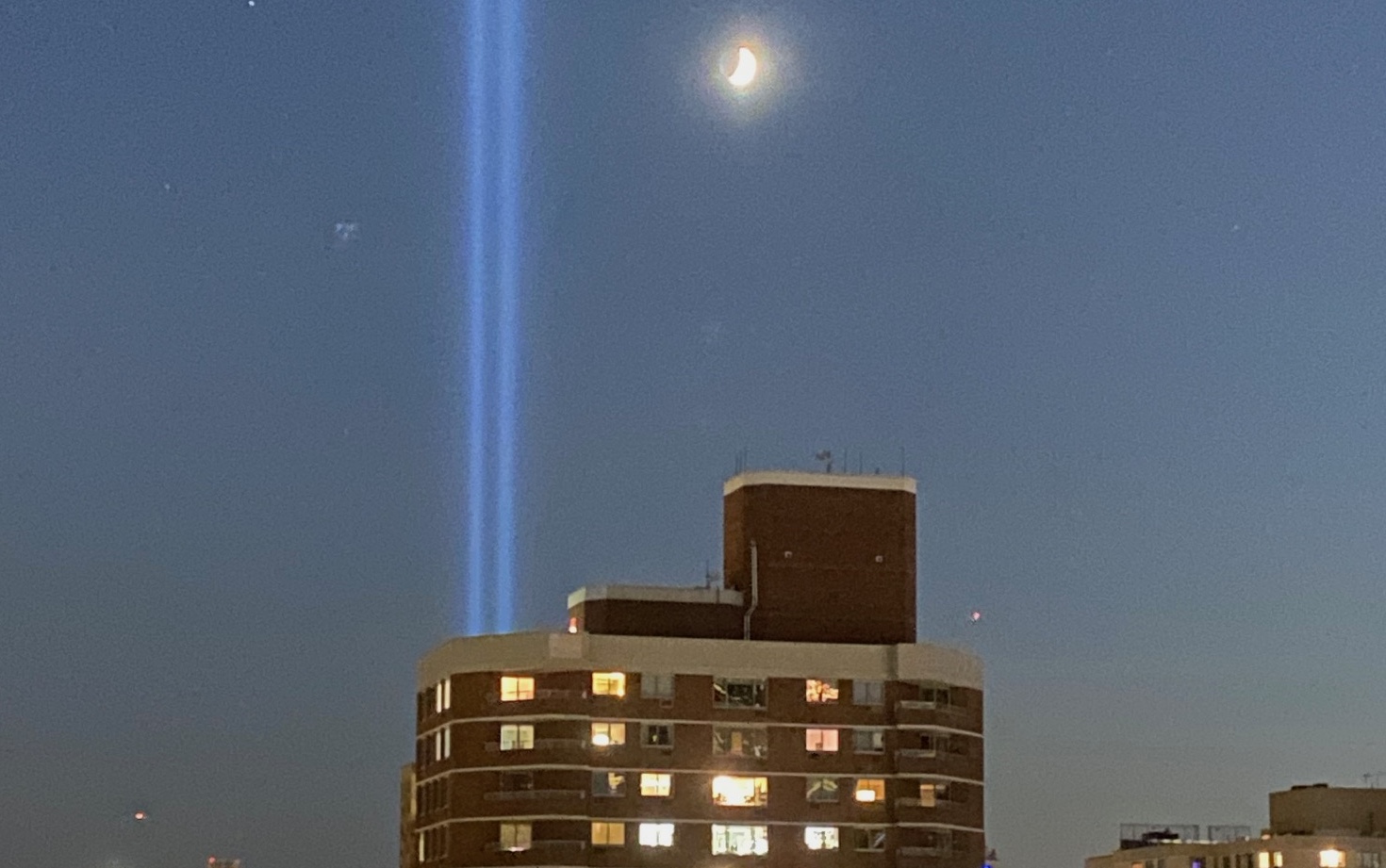
Tonight, as they have for the past few days, the twin rays of light from the 9/11 memorial will appear. From my window, they shoot straight up into the sky but from the ground they seem to stretch north across the sky, toward us, fading as they go until visible no more.