
A Love Story
This is Part 2 of the story of the search for my family’s European origins (Part 1 is here). Not to spoil anything, but this part doesn’t move that search any farther along (further back?). Not one bit. Instead it concerns a branch of a branch of my family. It only goes back to 1836 and stays on this side of the Atlantic.
______________________
I’ve written that no one in my family ever showed much interest in finding out when my ancestors came to North America and from where. But that’s not to say there was no interest in our past at all.
Our most avid family historian was my cousin Chuck (my great grandmother, Mummum, the guiding spirit of this project, was his great grandmother as well). We had our share of old photos, but Chuck clearly had a large supply of his own and devoted a lot of his post-retirement time to sharing them, both by email and more widely on Facebook. There we were in many of them — dad, mom, Uncle Geno, Mummum, my brother and I, with Chuck, his parents and brothers. In faded Polaroids and Kodaks, the cousins often lined up by height, with carefully styled 70’s hair. There were historic pictures as well, including some turn-of-the-century photographs of Mummum with her parents and siblings and with her new husband, Charles Benton Gold, dressed in their finest, stiff and unsmiling.
Chuck also shared reports of family events from the archives ofThe Purcell Register, the local paper from a place that was my hometown but not his. He was the one who tracked down published stories from all over the state and country about Mummum’s return to sight — how the impact of a toddler’s wild swing of toy on the side of her head restored the vision she’d lost over 15 years earlier.
I’m still looking for the original National Enquirer piece about that. I know Chuck included a scan of it in a Facebook post a number of years ago. Sadly, he passed away in 2022, and his account appears to have been disabled.
But there is one primary resource from Chuck that I do have in hand.
In one of those sporadic moments when I got curious about my ancestry, I wrote to Chuck asking if he knew when the Elders or Golds crossed over from Europe. He quickly answered Yes! He had a whole history of the family! And there it was attached to his response, a 22-page story written by our great aunt, Willanna. The answer no one else seemed interested in was there all the time!
Except, it really wasn’t.
______________________
Willanna was born in 1900 and lived to be 98. Her mother and Mummum were sisters. She entitles her account of her family’s history, “The Story.”
And is it ever.
I’m not suggesting the Loves’ experience was any more eventful than that of any other 19th-century, westward-headed American family. But eventful it certainly was. I’ll share some highlights but there’s no use trying to fully summarize it. By cramming a century and a half into just over 20 pages, Willanna’s version is the summary.
She starts with the birth of her grandfather, John B. Love, in Tennessee. One sentence later, John (age 20) is married and is on his way to Missouri. Willanna then introduces what looks to be another main character: The Old Bureau, a massive handmade cherry wood dresser in John’s possession. She promises to keep us apprised of the bureau’s owner and location as it is passes to the eldest son of each subsequent generation.
After the first page (for some reason labeled Page 2), the version Chuck sent me skipped ahead to Page 7. I pointed this out and he sent a second file of the missing pages. But that insert was obviously from a newer copy of the story, created on a steady electric typewriter and single-spaced. The original was set down double-spaced on a jittery manual.
The two pieces don’t sync up perfectly. The first page of the original ends on an incomplete sentence, the insert starts with a new one, and the original resumes with some content overlap to the last page of the insert. I suppose I could have asked for the complete file of the newer version but there didn’t seem to be any gaps in the story.
For the first several pages, “The Story” plays out like How the West Was Won. Wagon trains, river crossings, cattle drives, the coming of the railroads, settlements becoming towns, the steady push westward. All that American stuff. We’re not a full page in before John B.’s brother, William, a mule trader, is killed by Comanches in Texas in 1853. At another point, a young man who would later become Mummum’s grandfather is panning for gold in California, at a place called Wooderig Diggins, not far from where the strike that started the Gold Rush happened.
There is no mention of the Civil War. Apparently, none of the Love men were caught up in the fighting.
There were more amicable interactions with Native Americans than what William Love experienced. His son, Robert J., stayed in Texas after his father’s death, working on ranches. He then moved to the Indian Territory to establish his own ranch. There he married Sally Criner, a Chickasaw whose father was a prominent cattleman, and whose grandfather served as the tribe’s National Interpreter. One afternoon after Mummum’s family moved to Indian Territory, her two older brothers “happened to meet three Indian maidens,” who followed them home. Willanna reports the young women returned to their own families without incident. A decade later, Mummum’s sister Maud married Jim Barnett, of enough Choctaw descent to have a land allotment.
Robert J., the author’s uncle, is the key figure in the story. Along with all of his other accomplishments, he’s the reason so much of my family lived in Purcell. Another way of putting it is that he’s the reason there was a Purcell to live in at all.
In the early 1870s, when delivering cattle to Kansas City, Robert J. met a railroad survey crew and learned that a train line was being planned to go through Indian Territory to Texas. He quickly bought up land along the South Canadian River near his ranch, much of it purchased from the Chickasaw Nation. He then hired a surveyor to map out a townsite, and put his own cowboys to work staking out lots for businesses and houses. Main Street and its intersecting streets were cleared and leveled by his mule teams. He sold the lots but donated land for churches, a school, and a cemetery. And indeed, the railroad came. He would go on to be president of the Chickasaw National Bank.
The town itself was named after Edward B. Purcell, an official of the Atchison, Topeka, and Santa Fe Railroad. Perhaps my relative was at heart a humble man or he and the other town fathers felt obliged to honor the man who chose Purcell for a depot, but it seems that I could have very easily grown up in Love, Oklahoma.
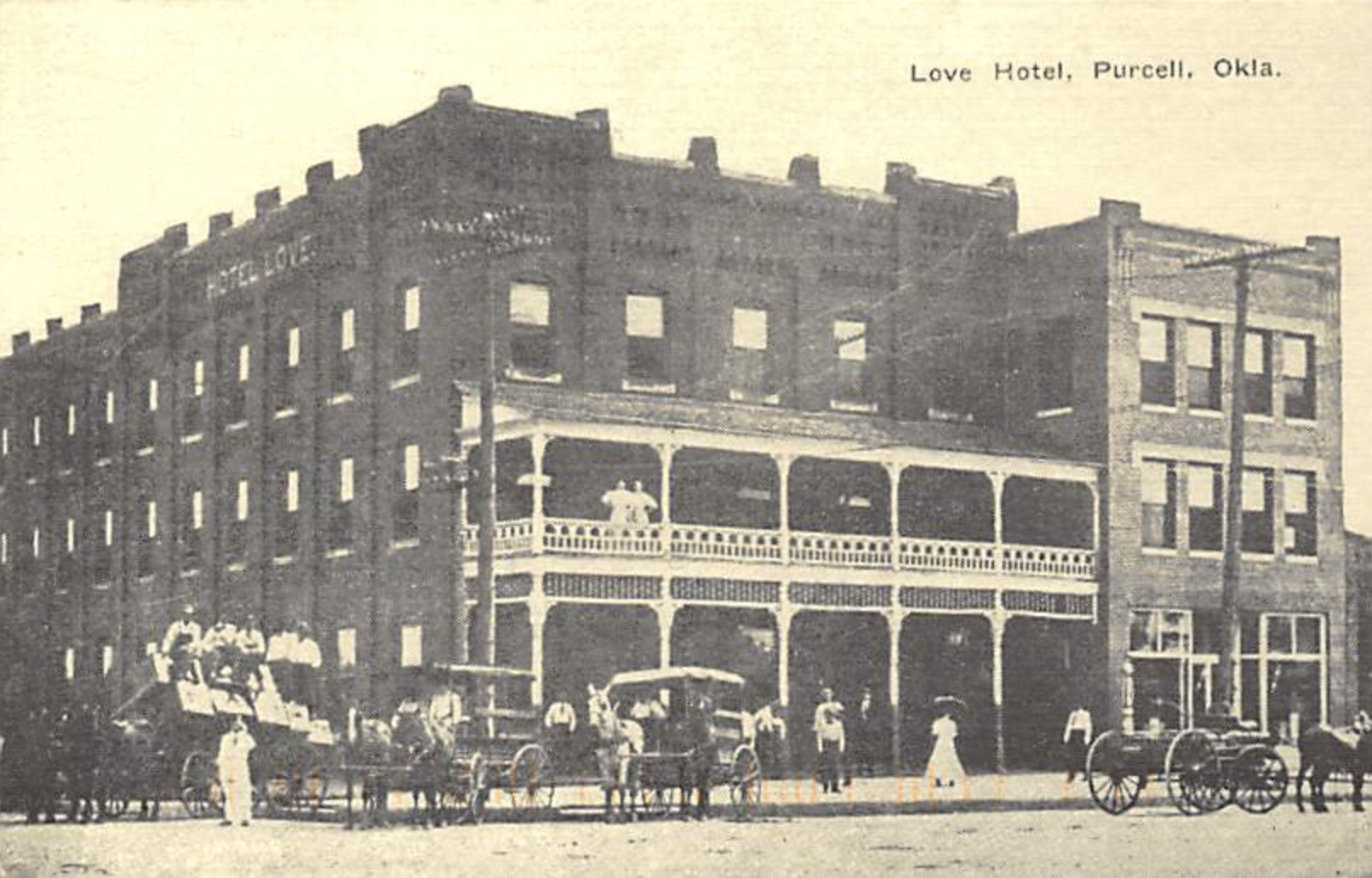
Reading about Robert J. answered a question I never got around to asking anybody in my family. In Purcell, on a corner of Main Street, there was (is) a three-story building that used to have its name painted directly onto the brick at the top of its eastern facade — Hotel Love. You can imagine the fun my adolescent and teenaged friends had with that. We called it the Love Hotel despite the building itself clearly having the words the other way around.
It’s in the National Registry of Historic Places now. It’s not in operation for lodgings and the name has been painted over, but it’s been carefully restored inside and out. The first two floors are now an antique store. When I was growing up in Purcell, the ground floor was Kennedy’s Drug Store, where my dad in his teenage years worked as a soda jerk, paper hat and all, making fountain Coca Colas by mixing syrup and carbonated water.
But other than being my dad’s former place of employment, I never knew the deeper family connection to the hotel. Now I do. The “Love” of the Hotel Love is Robert J. My great grandmother’s sister’s husband’s cousin built it.
______________________
There are two Robert Loves to keep up with in the first part of Willanna’s story. Robert J. had a younger cousin, Robert Alton (son of John B). Robert Alton went to work for his older cousin when he was still a teenager. Thirteen years later he had amassed enough savings and livestock to start a ranch of his own. That same year, 1892, he married Mummum’s sister, Lottie Nix.
Robert Alton and Lottie were Willanna’s parents.
Lottie was one of eight children of John Thomas and Milcah (Milkey) Nix. The Nixes, including Lottie and two other children, moved by wagon train from Georgia to Aurora, Missouri, in 1873. Five more children were born to John Thomas and Milkey in Aurora, including Myrtle (Mummum). Around 1890, the whole family relocated again — again by wagon train — to establish a wheat farm near the Loves’ ranches., close to Purcell. The “Indian maidens” incident with Mummum’s brothers happened shortly thereafter.
Here’s what I learned about Mummum from “The Story.” First, I thought I knew that her birthplace and the start of her journey to Oklahoma was Pennsylvania. Nope, Missouri. The move was indeed by wagon train, so at least I don’t have to stop saying that. Next, Willanna reports that all of the Nix children were excellent students and gardeners, devout churchgoers, and together something of a family band. Young Myrtle played the accordion! I also learned how she met her husband Charles Benton Gold. Originally from Illinois, Charles was a railroad mechanic who came to Purcell from Fort Worth to work at the roundhouse. He met Myrtle, stayed, married her.
______________________
The first half of Willanna’s story is full of incidents and character details – she’s writing about people she’d known all her life or heard about firsthand. But once she gets to her children’s generation, things speed up and spread out. It’s less How the West was Won and more The Book of Chronicles, or as we used to call it in Sunday School, the “Begats” (“And Cush begat Nimrod,” etc.). Sons, daughters, nieces, and nephews marry and have children, who then marry and have children, all the way up through the late 20th century. A lot of families are on the move, within Oklahoma and to other states, mostly headed westward. My father, mother, brother, and I appear by name on the next to last page.
Surprisingly, there’s no account of Mummum’s stunning return to sight. Willanna never mentions it.
But there is a section on Willanna’s niece Margaret (the family called her Margie). She’s the daughter of Willanna’s brother, Frank — one of the brothers who met those “Indian maidens.” (I can’t keep the song, “Cherokee Maiden” out of my head now). A long paragraph covers Margie’s marriage to Braxton Combs, their move to central California, and births of their children, including my cousin Annie. Willanna refers to Annie as “currently pursuing the Performing Arts in New York.”
Enter Cousin Annie.
______________________
“You know, you have a cousin that lives in New York.”
This was casually mentioned by my grandmother, Bertha Mae, in a phone conversation in 1987, about a year after I moved to the city. She had a habit of introducing things that way, saying, “You know” to preface something I had no way of knowing. Mom used to do that as well.
Mae wasn’t sure of my actual relationship to Annie. She was mom’s mother and Annie was from dad’s side of the family. But she knew she was an aspiring actress and that we were cousins of some kind. A few years later, one afternoon at the Peacock Caffe on Greenwich Avenue, Annie, her parents, and I mapped out the exact relationship, with Braxton drawing a family tree on a napkin. We’re second cousins once removed.
So, you know, cousins.
Mae got a phone number for Annie from Willanna and passed it along to me. I called and left my name, number, and a message:
“I know this sounds weird, but I seem to be a cousin of yours of some kind and I live in New York now.”
She called me back anyway.
We first met face to face on the location set for the movie version of Bright Lights, Big City on Bedford Street in the Village. She was dating someone involved in the production and that’s where she said she be that evening.
By then I’d become accustomed to seeing a New York block taken over by a movie or television shoot: trailers, lots of thick cables and imposing equipment, food tables, more people with headsets rerouting pedestrians than seemed necessary. The filming itself was happening inside Chumley’s, the legendary bar entered through an unmarked entrance tucked into an apartment courtyard. You had to know it was there. Up until that night, I hadn’t.
There was no signal established for recognizing each other, no sign/countersign. I just knew it was her when I saw her, and she seemed to know it was me.
I could go on and on about good times with Cousin Annie — New York, Paris, Cape Cod, LA; the first time I drove in New York, the second and last time I hitchhiked (on that Paris visit when she lived there). The time years after she relocated to California that we found ourselves back to back at the crowded bar at, yes, Chumley’s, neither knowing the other was planning to be there that night.
But now I’ll fast-forward to seeing Annie’s name in the latter portion of “The Story.” Before finishing the story myself, I forwarded the file to her, copying original source Chuck to explain who she was.
I suspect Annie got no further than the first half of the first page before responding. It happened that fast.
Remember “The Old Bureau?” The handmade dresser first described at the beginning of “The Story?” Willanna promised to follow that dresser from caretaker to caretaker down through the generations, but it fades out of the story pretty early. After the first page it’s mentioned only once (page 13) as it is being taken by station wagon to San Diego in the 1920s. From there, its ultimate fate is left unknown.
Until I sent “The Story” to Annie.
“The Old Bureau!” she wrote — I could practically hear her exclaim it. “It’s in my brother’s house in Sacramento. I’ve been trying to talk him out of it for years!”
______________________